

Introduction
Strong local search rankings are often treated as the ultimate sign of SEO success. A business reaches the first page for its most important keywords, begins attracting more website visitors, and sees an increase in customer inquiries. After months of consistent improvements, its search presence appears to be working exactly as intended. However, something unexpected can happen once those rankings become established: growth begins to slow, even though the business continues performing well in search results.
This situation can be particularly frustrating for business owners and marketing professionals. The company may maintain prominent positions for its main services, publish useful website content, and continue investing in optimization, yet the number of new customers remains relatively unchanged. Rankings are stable, but the business is no longer experiencing the same level of improvement that accompanied its earlier SEO progress. The natural assumption is that something must be wrong with the strategy, but the explanation is often more complicated.
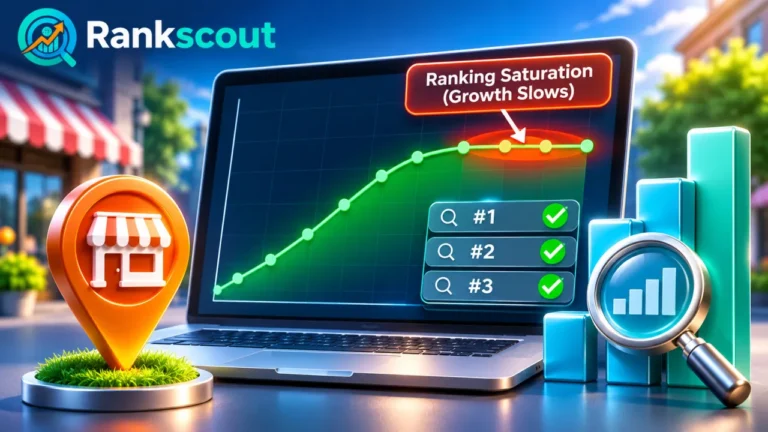
One possible cause is local search ranking saturation, a situation where a business has captured much of the practical visibility available within its existing keyword targets. Instead of experiencing continuous growth from the same searches, the company reaches a point where further ranking improvements offer increasingly limited opportunities. It may already appear prominently for its core services, leaving fewer meaningful gains available without expanding its understanding of customer demand.
Local search ranking saturation is not an official search engine ranking factor or a fixed performance threshold. It is a useful concept for examining why strong search positions do not always produce continued business growth. Understanding this distinction helps companies recognize when their current keyword strategy has reached a natural limit and when new opportunities may exist beyond the searches they already dominate.
Understanding the Local Search Ranking Saturation Effect
Local search ranking saturation occurs when a business has developed strong visibility across its existing priority keywords but finds that additional improvements produce smaller commercial benefits. This does not necessarily mean the website has stopped performing effectively. Instead, the business may have reached a relatively mature position within a limited portion of its local search market.
Consider a plumbing company that ranks prominently for general plumbing services, emergency plumbers, and local plumbing contractors. These searches may generate consistent inquiries and represent an important source of revenue. However, once the company has established strong positions for these terms, moving slightly higher may not produce the same improvement in customer demand that occurred when it first became visible.
The number of people searching for those services is not unlimited. Customer demand changes with seasonality, local conditions, competition, and the size of the market. Even a business with excellent visibility cannot attract customers who are not currently searching for its services. This creates a practical limit on the growth available from any fixed collection of keywords.
The problem becomes more significant when a company continues concentrating most of its SEO resources on searches where it already performs well. Small ranking movements may receive considerable attention while other relevant services remain underrepresented. The business becomes highly visible within a narrow search category but fails to develop its presence across the broader range of customer needs.
Recognizing local search ranking saturation allows businesses to distinguish between maintaining established performance and creating additional opportunities. Both activities matter, but they require different decisions. Protecting valuable rankings supports existing demand, while expanding into relevant underserved searches can create new paths for growth.
Why High Rankings Do Not Guarantee Continuous Growth
Search rankings represent a business’s position within a particular set of results, but they do not determine the total amount of demand available. A company can occupy a strong position for an important keyword and still experience limited growth if the number of potential customers searching for that service remains stable.
This distinction is important because SEO performance is often evaluated through ranking improvements alone. Moving from a weak position to a prominent one can increase the opportunity for discovery. However, once a business is already highly visible, further gains may offer less additional exposure. The commercial benefit depends on the search term, competing results, customer behavior, and the business’s ability to convert interest into inquiries.
A roofing company might rank strongly for roof repairs in its primary service area. If that search already generates a steady flow of customers, maintaining the position remains valuable. However, the company may struggle to increase demand significantly without becoming more visible for related services such as roof inspections, storm damage repairs, or commercial roofing maintenance.
Another consideration is that rankings do not guarantee customer action. People may compare several providers, return to businesses they already know, or decide not to purchase immediately. A strong search position creates an opportunity to be considered, but the quality of the website, clarity of the service offering, pricing, and customer expectations influence what happens afterward.
Local search ranking saturation therefore highlights the difference between search performance and market growth. Businesses should continue protecting their established visibility, but they should not assume that maintaining the same rankings will automatically generate increasing customer numbers year after year.
Recognizing the Warning Signs of Local Search Ranking Saturation
One of the clearest signs of local search ranking saturation is a prolonged period of stable rankings accompanied by relatively flat search-driven business results. A company may continue appearing prominently for its main keywords while website visits, qualified inquiries, and new customer numbers show little sustained improvement.
However, flat performance alone does not prove that saturation has occurred. Changes in search demand, website conversion rates, competitive conditions, and broader economic activity can produce similar patterns. Businesses should investigate these factors before concluding that their existing keyword opportunities have been exhausted.
Another warning sign is excessive concentration around a small collection of search terms. A business may receive most of its search exposure through a few general service keywords while remaining difficult to discover for specialist offerings. This can create the appearance of strong overall performance even though important parts of the market remain underserved.
Repeated optimization of already successful pages can also indicate a narrow strategy. If a company continually adjusts content targeting keywords where it already ranks prominently, the potential benefit of each additional change may become smaller. Meanwhile, pages supporting other profitable services may receive little attention.
A further signal appears when the business expands its services but its search strategy remains unchanged. A contractor might introduce new installation services, or a professional firm might begin offering specialist consultations, yet its website continues concentrating on the same established keywords. In this situation, the business’s commercial capabilities have grown faster than its search presence.
Identifying these patterns helps companies determine whether they need better performance from existing traffic, broader keyword coverage, or a combination of both.
The Connection Between Keyword Concentration and Ranking Saturation
Keyword concentration occurs when a large proportion of a website’s search visibility comes from a relatively small group of closely related searches. Concentration is not inherently negative. For a specialist business, a focused keyword strategy may be entirely appropriate. Problems arise when that concentration prevents the company from reaching other relevant customers.
For example, an accounting firm might perform strongly for general bookkeeping services while receiving limited visibility for payroll support, financial reporting, or business tax preparation. If these additional services represent important revenue opportunities, the firm’s existing search presence may not fully reflect its capabilities.
The same issue can affect businesses with multiple customer segments. A cleaning company might attract substantial residential interest while remaining largely invisible to commercial property managers. Its rankings may look impressive, but the search audience may not match its wider growth ambitions.
Addressing concentration requires examining the relationship between keywords and actual customer needs. Several similar search phrases may represent one underlying service opportunity, while a single specialist keyword category may connect with an entirely different group of potential buyers.
Businesses should therefore organize their search priorities around meaningful service categories rather than treating every keyword as an independent opportunity. This provides a clearer picture of where visibility is established and where additional coverage could support growth.
A balanced strategy does not require abandoning successful keywords. Instead, it protects the searches that already contribute value while gradually developing visibility across other commercially relevant categories.
Finding New Customer Demand Beyond Established Rankings
When a business encounters local search ranking saturation, the next opportunity may exist in customer needs that its current keyword strategy does not adequately address. Discovering these opportunities requires looking beyond the most familiar industry phrases and examining how potential customers describe their problems.
Customer conversations can be especially useful. Sales inquiries, consultations, and service requests often reveal questions that people ask before choosing a provider. These questions may differ from the terminology businesses use internally, creating opportunities for content that better reflects real search behavior.
A heating contractor, for example, may focus heavily on broad HVAC service terms while overlooking searches about uneven heating, unusual furnace noises, or replacing an aging heating system. These searches may represent customers at different stages of the purchasing journey, but each can connect with services the company provides.
Search opportunities can also emerge from changes in the business itself. New services, expanded operating areas, specialist expertise, and different customer groups may justify a reassessment of keyword priorities. A company that has evolved beyond its original offering should ensure that its website reflects those developments.
Not every newly discovered keyword deserves investment. Businesses should consider whether the search relates to a service they can deliver, whether the potential customer is commercially relevant, and whether the opportunity supports their wider objectives.
The goal is to identify meaningful demand rather than simply increase the number of keywords associated with the website. A smaller collection of relevant new searches may provide greater value than a large expansion into topics with little connection to customer purchasing decisions.
Expanding Service Visibility Without Weakening Existing Rankings
One concern when moving beyond established keywords is the possibility of disrupting pages that already perform well. Businesses may be tempted to rewrite successful service pages extensively to accommodate additional topics, but this can weaken clarity and make it harder to understand the purpose of each page.
A more measured approach begins by identifying whether the new opportunity genuinely belongs within existing content. If a related customer question can be answered naturally on an established service page, improving that page may be appropriate. If the opportunity represents a distinct service or customer need, a dedicated page may provide a clearer experience.
For example, a company offering general electrical repairs might introduce specialist commercial electrical inspections. Although the services are related, customers may have different requirements, questions, and purchasing considerations. A separate page explaining the specialist service could provide more useful information than adding a brief paragraph to an existing general page.
Internal links can help connect related information and guide visitors toward relevant services. Supporting articles may also answer questions that arise earlier in the customer journey, creating a natural path from research to service consideration.
The important principle is to preserve the usefulness of established content while improving coverage where genuine gaps exist. Creating numerous repetitive pages to target minor keyword variations is unlikely to provide the same value as developing clear, distinct information around meaningful customer needs.
Local search ranking saturation should encourage thoughtful expansion rather than uncontrolled content production.
Geographic Expansion and the Limits of Local Market Demand
Geography can place practical limits on local search growth. A business may already have strong visibility in its primary service area, but the number of potential customers within that market may remain relatively stable. Expanding into nearby locations can create additional opportunities, provided the business can serve those customers effectively.
However, geographic expansion should not be treated as an automatic solution to local search ranking saturation. Different communities may have different levels of demand, stronger competitors, or service requirements that affect profitability. A location that appears attractive because of its population may not necessarily offer the best commercial opportunity.
Businesses should evaluate geographic expansion alongside operational capacity. Travel time, staffing, service availability, and customer expectations can influence whether attracting customers from another area makes practical sense.
A company serving several towns should communicate its coverage accurately and provide information that helps customers understand whether its services are available in their location. Where location-specific content is genuinely useful, it should reflect meaningful differences rather than repeat identical descriptions with different place names.
Geographic growth can also occur within an existing service area. A business may be well established in one neighborhood but less visible in nearby communities that it already serves. Understanding these differences can reveal opportunities without requiring a major operational expansion.
The objective is to align search visibility with realistic market potential. Reaching more locations is only valuable when those locations contain customers the business can serve profitably and reliably.
Measuring Whether Ranking Saturation Is Affecting Business Growth
Evaluating local search ranking saturation requires examining several performance indicators together. Rankings provide an important starting point, but they cannot independently explain why customer growth has slowed.
Businesses should first review the performance of their established keyword groups. Are rankings genuinely stable, or are important searches gradually declining? Is visibility concentrated around a few services, or does the website maintain useful positions across its wider offering?
The next consideration is search demand. A business may maintain its rankings while receiving fewer visits because fewer customers are searching for its services. Seasonal patterns, changing consumer preferences, and market conditions can all influence this relationship.
Website performance should also be considered. If search visibility remains strong but inquiries decline, the issue may involve the experience visitors encounter after reaching the website. Unclear service descriptions, outdated information, or difficult contact processes can prevent existing visibility from producing its potential value.
Inquiry quality adds another layer of understanding. A business might receive a similar number of leads while experiencing a decline in their commercial relevance. This could indicate that its keyword priorities are attracting people whose needs do not match its most valuable services.
A useful assessment compares these patterns over time rather than relying on a single reporting period. The objective is to determine whether growth has slowed because the business has reached the practical limits of its current search audience or because another part of the customer journey needs improvement.
This distinction helps prevent unnecessary changes to successful SEO work and directs attention toward the most credible opportunities.
Avoiding the Mistake of Chasing Endless Keyword Expansion
Once a business recognizes that its existing rankings offer limited additional growth, it may be tempted to target as many new keywords as possible. However, uncontrolled expansion can create a different problem: a website that covers numerous subjects without establishing clear relevance to its most important services.
Not every search opportunity deserves equal attention. Some keywords attract visitors with little intention of purchasing, while others relate to services that generate limited profit or fall outside the company’s practical capabilities.
Businesses should evaluate new opportunities through a combination of customer relevance, commercial value, competition, and available resources. A highly specific search connected to a profitable service may deserve greater attention than a broad phrase with much higher search volume.
Content quality must remain central to this process. Publishing numerous pages that repeat similar information can make the website harder to navigate and create confusion about which pages serve particular customer needs.
A focused expansion strategy allows businesses to develop new service categories gradually while maintaining the clarity of their existing website. This approach also makes performance easier to evaluate because changes can be connected with specific objectives.
The purpose of overcoming local search ranking saturation is not to pursue endless visibility. It is to discover additional customer demand that the business is genuinely equipped to serve.
Building a Sustainable Strategy Beyond Ranking Saturation
A sustainable local SEO strategy should balance the protection of established rankings with the development of new opportunities. Businesses need to maintain the content and website experience that already support customer discovery while remaining responsive to changes in demand.
Regular performance reviews provide the foundation for this balance. By examining important keyword groups, service visibility, geographic coverage, and customer outcomes, companies can identify whether their search presence continues to reflect their commercial priorities.
When established rankings remain strong, the next improvement may involve strengthening the experience visitors receive rather than pursuing another position increase. Clearer service information, better navigation, and more useful answers to customer questions can help businesses make better use of existing attention.
When relevant service categories remain underrepresented, the priority may shift toward developing more complete content coverage. Businesses can identify the most valuable gaps, make focused improvements, and evaluate how visibility changes over time.
This process should remain flexible. A keyword category that offers limited growth today may become more important as customer demand evolves. Similarly, a service that once represented a major opportunity may become less central to the business’s future direction.
Agencies and marketing professionals can use this approach to communicate progress more meaningfully. Rather than treating every reporting period as a competition to achieve more rankings, they can explain how established visibility is being maintained and where additional commercial opportunities are developing.
Long-term success comes from understanding when to strengthen existing performance, when to expand into new searches, and when the greatest opportunity lies outside rankings themselves.
Conclusion
Strong local search rankings are valuable, but they do not guarantee unlimited growth. A business can establish prominent positions for its most important keywords and eventually reach a point where additional ranking improvements offer increasingly limited commercial benefits.
Local search ranking saturation provides a useful framework for understanding this challenge. It encourages businesses to distinguish between maintaining established visibility and discovering new opportunities for customer acquisition.
By examining keyword concentration, service coverage, geographic demand, and customer behavior, companies can identify whether their existing strategy has reached a natural limit or whether other factors are restricting growth.
The solution is not necessarily to pursue more keywords or make constant changes to successful pages. Instead, businesses should protect valuable rankings, improve the usefulness of their website, and expand into relevant searches that reflect genuine customer demand.
Ultimately, sustainable local SEO depends on more than achieving strong positions. It requires an ongoing understanding of where customers are searching, which services matter most, and how search visibility contributes to business objectives.
Businesses that recognize the limits of their existing rankings can make more informed decisions and create new opportunities without sacrificing the progress they have already achieved.
Understanding where your search rankings are strongest is an important step toward identifying where further growth may be possible.
Rankscout helps businesses and SEO professionals track keyword performance, monitor search rankings, and use analytics reports to understand visibility trends over time. These insights can help you recognize established strengths, identify underperforming search categories, and make more informed decisions about your local SEO priorities.
Ready to move beyond your existing rankings? Visit Rankscout.app and start tracking the search opportunities that matter to your business.