

Introduction
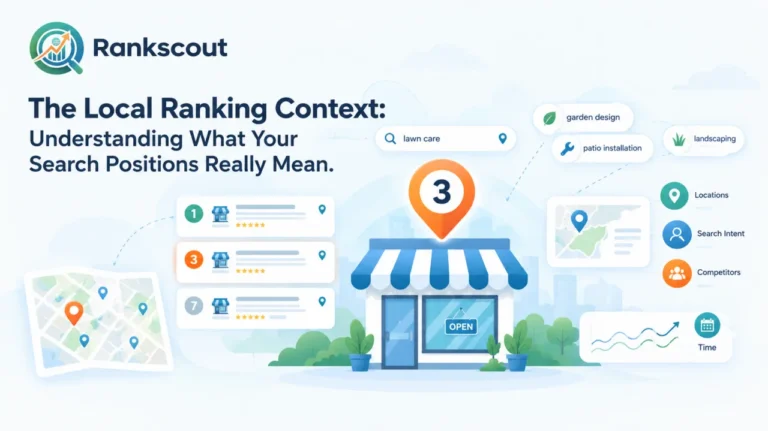
A local search ranking can look like a straightforward number, but the number itself rarely tells the entire story. Seeing a business in position three for an important keyword may appear to be an obvious success, while seeing it in position twelve may appear to be a problem. Yet rankings become much more useful when they are placed in context. The keyword being searched, the service behind it, the location involved, the customer’s intent, the businesses appearing alongside you, and the movement of the ranking over time can all change how that position should be understood. This is why local ranking analysis is more valuable than simply checking where a business appears and recording the number. Effective analysis turns ranking data into information that can reveal patterns, priorities, and changes in the local search environment.
For businesses that depend on local customers, search visibility is rarely built around one keyword. A company may provide several services, operate in multiple areas, serve different types of customers, and attract people at different stages of the buying process. Each of those factors can influence the searches that matter. A business may rank strongly for its main service but struggle with a newer service. It may perform well for broad searches while having weaker positions for highly specific searches. It may also have stable rankings overall while experiencing meaningful changes within one important service category. Without context, those differences can disappear inside a basic ranking report. With proper local ranking analysis, however, they become useful evidence that can guide smarter decisions.
The purpose of tracking rankings should therefore be more than proving that a number moved upward. Ranking data should help businesses understand why visibility is changing, where it is changing, and what those changes mean for the wider local search strategy. That approach does not require reacting to every movement or treating every position as equally important. Instead, it means building a consistent way to interpret search performance so that decisions are based on patterns rather than isolated observations.
What Is Local Ranking Analysis?
Local ranking analysis is the process of examining local search rankings in context to understand patterns in visibility and search performance. Instead of looking at individual positions as independent numbers, it considers rankings alongside factors such as keyword relevance, service categories, locations, search intent, competitors, and changes over time. The goal is to understand what ranking data is actually telling you rather than simply documenting where a business appeared on a particular day.
This distinction is important because two keywords with the same ranking position can have completely different meanings. A business ranking in position four for a major service term may be in a very different situation from a business ranking in position four for a narrow, low-demand search. Similarly, moving from position nine to position six may be meaningful for one search but less significant for another. The number is useful, but the circumstances surrounding the number determine how much attention it deserves.
Local ranking analysis also helps prevent businesses from making decisions based on incomplete information. A single ranking check can capture one moment, but local search performance changes over time. Competitors can improve their visibility, customers can change the language they use, services can become more or less important, and search behavior can shift. Looking at ranking history provides the context necessary to separate a temporary movement from a broader trend.
Why Ranking Positions Need Context
One of the easiest mistakes in SEO is assuming that every ranking movement has the same meaning. A keyword moving two positions upward can look encouraging, but it does not necessarily indicate a broad improvement in search visibility. The movement could be isolated to one search while other related keywords remain unchanged. Likewise, a decline for one keyword does not automatically mean that an entire local SEO strategy is failing.
Context helps businesses interpret these changes more carefully. If ten keywords connected to the same service improve over several weeks, that pattern provides more information than one keyword moving upward by itself. If several related keywords decline at approximately the same time, the change may deserve closer examination. If only one keyword moves while everything around it remains stable, the movement may simply be an isolated fluctuation.
The most useful ranking data is rarely the number by itself; it is the pattern surrounding the number. Businesses should therefore look for consistency across related searches and consider whether movements are concentrated around particular services, locations, or types of customer intent. This creates a more accurate picture of search performance and reduces the temptation to overreact to individual ranking changes.
Local Ranking Analysis by Service Category
Businesses with multiple services should pay particular attention to how rankings perform across individual service categories. A general average ranking can hide major differences between parts of the business. If one service generates strong visibility while another receives little search exposure, combining the two into one overall figure may make the situation difficult to see.
Consider a home improvement company offering roofing, siding, windows, and gutters. Its overall local search performance could appear stable even if roofing rankings are improving while window-related searches are declining. If all the keywords are reviewed together without any grouping, the business may miss the fact that its visibility is moving in different directions across its services.
Organizing rankings into meaningful categories makes analysis more useful. Businesses can compare the performance of individual services, identify categories with sustained improvement, and recognize areas where rankings remain consistently weak. This does not mean that every weaker category needs immediate attention. Commercial priorities still matter, and some services may naturally generate more demand than others. However, understanding ranking performance by service gives businesses the information needed to make those priorities more deliberately.
Service-level analysis can also become particularly valuable when a company introduces something new. A new service may have little historical ranking data compared with established offerings, so its early performance needs to be viewed differently. Rather than expecting it to immediately match the rankings of mature services, businesses can track whether visibility is developing over time and whether the relevant search terms are beginning to move in the desired direction.
Local Ranking Analysis by Search Intent
Keyword intent is another important part of understanding ranking data. Customers searching for a broad category may be at a very different stage from customers searching for a specific service combined with a location. A person searching for information about a problem may not yet be ready to contact a business, while someone searching for a provider may be much closer to taking action.
This means businesses should avoid treating every keyword as equally valuable simply because it has a ranking attached to it. A ranking position should be considered in relation to what the search represents. A company may have excellent visibility for informational searches while having weaker rankings for searches that indicate stronger commercial intent. That does not make the informational visibility useless, but it creates a different strategic picture.
Local ranking analysis becomes more meaningful when rankings are connected to the customer journey. By separating searches according to the type of need they represent, businesses can determine whether their visibility is strongest at the beginning of the research process, closer to the point of purchase, or across several stages. This provides a more complete understanding of how search visibility supports customer discovery.
Understanding Ranking Trends Instead of Ranking Snapshots
A ranking snapshot answers the question, “Where are we today?” Historical data helps answer the more useful question, “Where are we going?” Both have value, but long-term trends generally provide more context for decision-making than isolated checks.
Suppose a business ranks between positions five and seven for an important group of keywords over several months. A single ranking of position five may look stronger than a previous position seven, but the larger pattern could show that the business has remained relatively stable. Conversely, a keyword that moves from position twenty to position twelve may still be outside the strongest part of the search results, but the direction of movement could indicate that visibility is developing.
This is why local ranking analysis should focus on movement over time rather than treating every ranking check as a separate event. Historical trends can reveal gradual improvements that are easy to overlook and declines that may not be obvious from a single report. They can also help businesses determine whether an apparent improvement is part of a sustained pattern or simply a short-term change.
The longer the ranking history, the more useful the comparisons can become. Businesses can compare recent performance with previous periods, evaluate groups of related keywords, and identify whether changes are isolated or widespread. This creates a more stable basis for SEO decisions than relying on occasional manual checks.
Comparing Rankings Across Locations
Location can significantly change the meaning of local ranking data. A business serving several communities should not assume that strong performance in one area represents equally strong performance everywhere. Search visibility can vary between locations, even when the business, services, and website remain the same.
For example, a service business may have an established presence in its primary city but weaker rankings in nearby areas it also serves. Looking only at the strongest location could create an overly positive impression of the company’s overall local search performance. Analyzing rankings by location makes these differences visible and provides a clearer picture of where the business is already well established and where its visibility is less developed.
Location analysis should also be interpreted alongside the business’s actual service area. A company may not need equal visibility in every nearby community if certain areas are outside its preferred customer base or are commercially less important. The objective is not to maximize rankings everywhere. It is to understand how visibility is distributed across the locations that matter to the business.
Good local ranking analysis asks whether search visibility matches the geographic priorities of the business. That makes location data more useful than simply counting how many places a business appears in search results.
Using Competitors as Context
Competitor rankings can provide another layer of context. Search results are competitive environments, so a business’s position is influenced not only by its own performance but also by what other businesses are doing. If several competitors begin appearing more prominently for a group of searches, the local search environment may be becoming more competitive.
This does not mean that every competitor movement requires a response. Businesses should avoid turning SEO into a constant reaction to every change made by another company. Instead, competitor visibility can be used to understand broader patterns. If competitors consistently perform strongly for a particular service, that may indicate that the category is highly competitive. If a competitor gains visibility across several related searches, it may be useful to investigate what has changed in that area of the market.
Looking at competitors can also help businesses distinguish between internal and external changes. A ranking decline becomes easier to interpret when you know whether competitors have simultaneously moved upward. If your position falls while competitors remain stable, the situation may warrant a different type of investigation than a situation where several businesses shift positions at the same time.
Turning Local Ranking Analysis Into Action
Data is only useful when it improves decision-making. Once a business has identified ranking patterns, the next step is to determine which findings deserve action and which can simply be monitored. This is where disciplined analysis becomes more valuable than constant reaction.
A business might discover that rankings for one service are improving steadily while another service remains stagnant. It might find that visibility is strong in one location but weaker in another. It might notice that commercial searches are underperforming compared with informational searches. Each finding provides a different type of information, and each can be considered alongside broader business priorities.
A useful process is to look for patterns that are consistent enough to justify attention. Instead of reacting to every individual movement, identify changes that appear across related keywords, services, or locations. Then consider whether the affected area matters commercially and whether there is a reasonable opportunity to improve it. This keeps SEO decisions grounded in evidence without turning ranking data into a source of unnecessary activity.
Common Mistakes in Local Ranking Analysis
One common mistake is focusing too heavily on average rankings. An average can be useful for summarizing a large dataset, but it can also hide important differences. If several high-value keywords decline while less important keywords improve, the average may remain relatively stable even though the business’s most important search visibility has changed.
Another mistake is measuring too few keywords. A small keyword set may be easier to manage, but it can provide an incomplete view of the business. If the tracked searches represent only one service or one customer intent, the resulting ranking data cannot tell you much about the rest of the search landscape.
Businesses can also make the mistake of reacting too quickly to short-term movements. Search rankings can change, and not every movement represents a lasting shift. Making major decisions based on a single ranking check can lead to unnecessary changes that are not supported by enough evidence. Consistent measurement and broader context create a more reliable foundation for deciding when a ranking movement actually matters.
Finally, businesses sometimes measure rankings without connecting them to business priorities. A keyword can be interesting from an SEO perspective without being particularly important commercially. The strongest analysis keeps both sides in view: what is happening in search and whether the search matters to the business.
Building a More Useful Local Ranking Analysis Process
A practical local ranking analysis process does not need to be complicated. It begins with identifying the keywords that genuinely represent the business’s services, customers, and locations. Those keywords can then be organized into useful groups so that ranking changes can be reviewed within context. Over time, businesses can compare those groups against previous periods and look for patterns rather than relying on individual ranking positions.
The next step is interpretation. When a meaningful change appears, ask whether it affects one keyword or a broader category. Determine whether it is connected to a particular service, location, or intent. Consider whether competitors have experienced similar changes. Then evaluate whether the affected area is commercially important enough to warrant further action.
This creates a repeatable approach to local SEO measurement. Instead of opening a ranking report and immediately looking for good or bad numbers, businesses can use the data to ask better questions. Which services are becoming more visible? Which locations remain difficult? Which customer searches are performing well? Where are competitors changing the competitive environment? Which movements are sustained rather than temporary? Those questions turn ranking data into a decision-making tool.
The Long-Term Value of Local Ranking Analysis
The greatest value of local ranking analysis comes from consistency. A business that measures rankings over a long period develops a historical reference point that can make future changes easier to understand. Rather than viewing every new ranking as a completely separate event, the business can compare current performance with what has happened previously.
This historical perspective becomes increasingly useful as a business grows. New services can be evaluated against established ones. New locations can be compared with existing markets. Changes in customer demand can be considered alongside ranking trends. Competitive shifts can be observed over time rather than interpreted from a single moment.
The result is a more mature approach to local SEO. Rankings remain important, but they are no longer treated as isolated scores. They become evidence that can be combined with other information to understand the direction of search visibility. Local ranking analysis helps businesses move from simply tracking positions to understanding what those positions reveal about their search presence.
Conclusion
Effective local SEO measurement is not simply about knowing where a business ranks. It is about understanding what those rankings mean. A position can change because of many different factors, and the significance of that movement depends on the keyword, service, location, customer intent, competitive environment, and historical trend surrounding it. By applying local ranking analysis, businesses can move beyond isolated ranking checks and develop a clearer understanding of how their search visibility is developing.
The strongest approach is to organize keywords around meaningful business categories, analyze rankings across services and locations, consider search intent, monitor changes over time, and use competitors as context rather than as a reason to react to every movement. This makes ranking data more useful because it connects search performance with the real structure of the business and the customers it is trying to reach.
For businesses that rely on local search, the goal should not be to chase every ranking change. It should be to understand the patterns that matter, recognize where visibility is developing, identify areas that deserve further attention, and make decisions based on consistent evidence. When ranking data is analyzed in context, it becomes much more than a list of positions. It becomes a way to understand local search performance and make more informed SEO decisions.
If you want a practical way to monitor and understand your local search performance, Rankscout brings together Keyword Tracking, Rank Monitoring, Analytics Reports, Easy Client Management, and flexible Token Top-Ups and Promo Codes in one platform. Use Rankscout to keep track of ranking performance over time, turn search data into clearer insights, and make local SEO reporting easier to manage. Get started with Rankscout today and bring more clarity to your local ranking analysis.