

Introduction
Local search intent alignment addresses this challenge by connecting the reasons people search with the information a business provides online. Every search reflects a need, question, preference, or intended action. Someone searching for a nearby restaurant may want somewhere open immediately, while another person may be comparing menus for a planned celebration. A homeowner searching for a plumber may need emergency assistance, or they may be researching a major renovation that will take place several months later. Although these searches belong to the same general industry, they represent different customer situations.
Understanding those differences helps businesses create more useful pages, target more relevant keywords, and guide visitors toward appropriate next steps. Instead of trying to attract every possible searcher, a business can concentrate on the searches most closely connected to its services, its customers, and its commercial goals. This makes local SEO more purposeful because visibility is evaluated according to the needs it reaches, not simply the number of keywords that appear in a ranking report.
The challenge is that search intent is not always obvious from a keyword alone. Small wording differences can signal substantial differences in urgency, expectations, and readiness to buy. Businesses that recognize these signals can build a clearer connection between search demand and customer needs, helping their websites become more relevant to the people they are best equipped to serve.
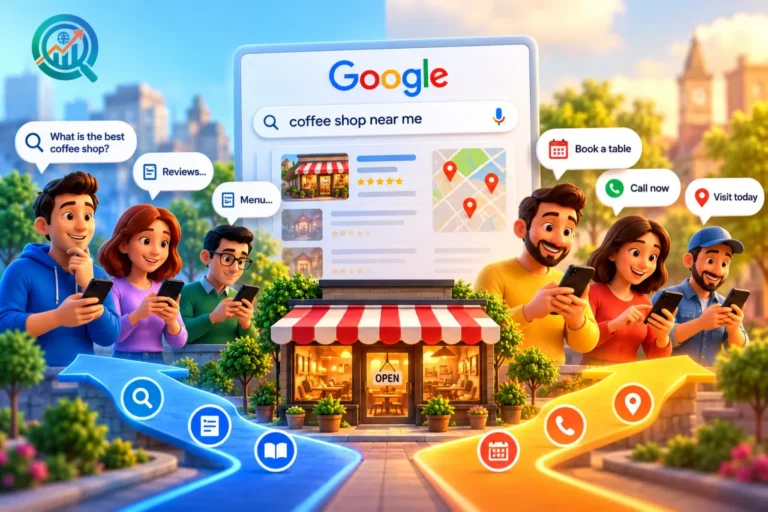
The Meaning Behind Local Search Intent Alignment
Local search intent alignment describes how closely a business’s online presence matches the needs behind the searches it wants to attract. It involves more than inserting location names into page titles or repeating service keywords throughout a website. The deeper task is understanding what searchers expect to find and making sure the business provides information that satisfies those expectations.
Consider the difference between searching for “best family dentist,” “emergency dentist near me,” and “dental implant consultation.” All three searches relate to dental care, but each suggests a different situation. The first search may involve comparing providers and evaluating suitability for a family. The second signals urgency and a need for immediate information about availability. The third points toward a specific treatment and may involve a longer decision process.
A single general dentistry page may struggle to address all three needs equally well. It could describe the practice accurately without answering the urgent questions of someone experiencing dental pain or providing the detailed treatment information expected by someone considering implants. The issue is not necessarily that the page lacks keywords. It may simply be organized around the business rather than the searcher’s needs.
Effective local search intent alignment begins by examining the questions, expectations, and decisions associated with important searches. What does the person want to accomplish? What information would help them move forward? Are they looking for a service, comparing providers, checking availability, or seeking an answer before making a decision?
The answers influence how website content should be structured, which pages should exist, and what information should receive the most attention. They also help businesses distinguish between traffic that looks impressive in a report and traffic that has a realistic chance of becoming a customer.
When search intent guides the strategy, every page has a clearer purpose. The website becomes less like a collection of service descriptions and more like a useful resource that meets people at different stages of their decision-making process.
Why Local Visibility Can Attract the Wrong Customers
Strong search visibility does not automatically translate into qualified leads. A business may appear for a broad range of keywords and receive visitors without generating the calls, appointments, or inquiries it expects. This can happen when the terms attracting traffic do not closely match the services the business provides or the customers it wants to reach.
For example, a premium landscaping company might attract visitors searching for inexpensive lawn maintenance, even though its primary services involve complex garden design and high-value outdoor projects. Those visitors may leave after discovering that the company’s services do not match their budget or needs. The website has attracted attention, but that attention has limited commercial value.
The opposite problem can occur when a business focuses too heavily on broad industry terms. A local legal practice may want to attract clients seeking help with a specific type of case, yet its website may concentrate on general legal information. It could receive visitors who are researching the profession rather than people looking for the services the practice actually offers.
Geographic intent can create another mismatch. A business may attract searches from areas outside its practical service range. While those visitors may be interested in the company, they are unlikely to become customers if the business cannot serve their location. Clear information about service areas can help set expectations and reduce confusion.
Businesses should therefore assess search visibility in relation to relevance. Which searches attract the most useful visitors? Which pages generate meaningful inquiries? Are people finding the company through the services it most wants to grow? These questions help reveal whether the website is attracting an appropriate audience.
When the wrong searches dominate performance, the solution is not always to increase traffic. It may be more effective to refine keyword targeting, improve page relevance, or clarify the services and locations the business supports. A smaller audience with a stronger connection to the company’s offerings can be more valuable than a much larger audience with little intention of becoming a customer.
The Different Intent Patterns Behind Local Searches
Local searches often fall into recognizable intent patterns, although individual searches can combine several motivations. Understanding these patterns helps businesses organize their content around customer needs rather than treating every keyword as an interchangeable route to a website.
Some searches are driven by immediate action. A person looking for an emergency electrician or a pharmacy open late may need a service within a short period. Their priorities often include availability, proximity, contact information, and confidence that the business can help. Content targeting these searches should make essential information easy to find without forcing visitors to navigate several pages.
Other searches reflect comparison and evaluation. Someone looking for a reliable roofing contractor may compare services, experience, project types, and customer feedback before deciding whom to contact. These searchers may not be ready to make an immediate purchase, but they are moving toward a decision. Clear service descriptions and helpful explanations can support that process by addressing reasonable questions and establishing what the business offers.
Research-oriented searches involve people who want to understand a problem or explore possible solutions. A homeowner investigating signs of foundation damage, for example, may not yet know whether professional repairs are necessary. Useful educational content can explain warning signs, common causes, and circumstances in which an expert assessment may be appropriate. Such content can build trust before the person begins comparing providers.
Some searches are highly specific. A customer might look for a particular treatment, product, repair, or specialist service in a defined area. These searches can signal a close match between the customer’s needs and a business’s offerings. Dedicated pages that explain the specific service may be more appropriate than broad pages that cover several unrelated topics.
Intent can also change as people learn more. A person who begins by researching a problem may later search for a service provider, compare nearby businesses, and finally look for directions or contact details. A useful website supports these changing needs by making the next logical step easy to understand.
The purpose of identifying intent patterns is not to place every search into a rigid category. It is to recognize meaningful differences and ensure that the website offers an appropriate response to each important customer need.
Matching Local Keywords With the Right Website Pages
Keyword selection becomes more effective when businesses consider which page should answer each search. A common weakness in local SEO is attempting to make one page rank for too many services, customer needs, and search variations. Although the page may mention all those subjects, it can become too broad to satisfy any of them particularly well.
A business offering heating and cooling services illustrates the problem. Installation, maintenance, emergency repairs, and indoor air quality are related, but they are not identical customer needs. Someone researching a new air conditioning system may want to understand installation options and long-term operating costs. A customer whose heating has stopped working may need repair information and a clear way to request assistance. Combining everything on one page can make it harder for either visitor to find the information they need.
Dedicated service pages provide a clearer structure when each service has enough substance to justify its own content. The page should explain what the service involves, who may need it, what the business provides, and what a customer can expect from the next step. It should also address the most relevant questions without adding unnecessary material simply to increase its length.
Local relevance should be integrated naturally. If a company serves several communities, its website should communicate those service areas accurately and provide useful information where appropriate. Creating multiple pages that differ only by a place name can lead to repetitive content that offers little value. A location page should have a genuine purpose, whether that means explaining service coverage, describing relevant local needs, or helping customers understand how to arrange a service in that area.
Keyword-to-page alignment also helps prevent internal competition. When several pages target the same search intent without a clear distinction, search engines and users may have difficulty understanding which page is most appropriate. A well-organized site gives each important page a defined role and connects related content in a logical way.
The goal is not to create a separate page for every wording variation. It is to build a structure that reflects meaningful differences in services and intent. When the right page answers the right question, the website becomes easier to navigate and more useful to both searchers and search engines.
How Customer Questions Reveal Hidden Search Opportunities
Keyword research tools can help businesses discover search terms, but customer conversations often reveal the reasoning behind those searches. People rarely describe their needs in exactly the same language a business uses internally. They may focus on a symptom, a concern, a desired outcome, or a practical obstacle rather than the formal name of a service.
A garage door company might describe its main offering as garage door repair, while customers search for a door that will not close, a noisy garage door, or a broken spring. These phrases reflect the problems people recognize before they know which service they need. Understanding that language can help the business create content that connects a real concern with an appropriate solution.
Customer service calls, sales conversations, email inquiries, and frequently asked questions can all reveal useful patterns. If customers repeatedly ask whether a service is suitable for older properties, how long a project takes, or what happens during an initial appointment, those questions may indicate information that is missing from the website.
Search intent alignment improves when businesses translate these observations into useful content. Instead of publishing generic articles simply because a topic appears popular, they can address specific uncertainties that prevent customers from moving forward. A well-written page can explain the service, set realistic expectations, and help readers determine whether contacting the business makes sense.
This process can uncover opportunities that broad keyword lists overlook. A company might already rank reasonably well for its main service but have little content addressing common concerns that arise before purchase. Providing those answers can improve the customer experience and create additional ways for relevant visitors to discover the business.
However, every question does not need a separate article. Related questions may belong together on an existing service page, while broader educational subjects may justify their own resources. The best format depends on the complexity of the topic and the purpose of the information.
By paying attention to the language customers use, businesses can build a more accurate picture of search intent. This helps content reflect real decisions and concerns rather than relying solely on assumptions made during keyword research.
Connecting Search Intent With Trust and Conversion
Relevance may bring the right visitor to a website, but trust often determines whether that visitor takes the next step. Local customers are frequently choosing between businesses that offer similar services. They need enough useful information to understand the company’s capabilities, assess whether it suits their needs, and feel comfortable making contact.
Trust begins with clarity. Service descriptions should explain what the business actually does rather than relying on vague claims about quality or excellence. A prospective customer should be able to understand the scope of a service, the types of situations it addresses, and whether the company appears suitable for the problem at hand.
Accurate business information also matters. Contact details, opening hours, service areas, and appointment information should be consistent and easy to locate. If a page attracts someone looking for urgent assistance but hides its phone number or provides unclear availability information, the business creates unnecessary friction at a critical moment.
Different search intents may require different next steps. Someone comparing contractors may want to review project examples or request an estimate. A person seeking emergency assistance may prefer an obvious contact option. A visitor researching a complex service may benefit from a consultation or a detailed explanation of the process.
Calls to action should reflect those differences. Repeating the same generic invitation on every page may overlook the specific decision the visitor is trying to make. A more useful approach gives people a logical next step based on the information they have just read.
Trust also depends on realistic claims. Businesses should avoid promising outcomes they cannot guarantee or presenting general information as a substitute for an individualized assessment when one is necessary. Honest explanations can help set expectations and reduce the risk of attracting inquiries based on misunderstandings.
The strongest connection between search intent and conversion happens when the entire experience feels consistent. The keyword matches the customer’s need, the page answers the relevant questions, and the next step is appropriate for the situation. Each element reinforces the others, making the website more useful and the business easier to evaluate.
Measuring Whether Local Search Intent Alignment Is Working
Businesses need more than ranking positions to determine whether their approach to search intent is producing meaningful results. Rankings can show whether pages are becoming more visible, but they cannot explain on their own whether the right people are finding those pages or whether visitors are taking useful actions afterward.
A practical evaluation begins by connecting important keyword groups with their intended pages and business goals. For example, a service page targeting high-intent repair searches should be evaluated differently from an educational article designed to answer early-stage questions. Both may contribute to growth, but they serve different purposes.
Organic traffic can reveal whether a page is attracting more visitors, while engagement and conversion data can help indicate what those visitors do next. Depending on the business, useful outcomes might include phone calls, quote requests, appointment bookings, consultation requests, or completed purchases. The most appropriate measures depend on how the company generates revenue.
If a page gains visibility but attracts few qualified inquiries, the business should investigate rather than assume that the ranking improvement has failed. The page may be reaching searchers with different needs, the information may not answer their questions, or the next step may be unclear. Search terms and visitor behavior can help narrow down the possibilities.
If inquiries increase without a major change in rankings, the page may have become more persuasive or useful to visitors who were already discovering it. This is another reason to consider search visibility and conversion performance together rather than relying on a single metric.
Businesses should compare results over consistent periods and account for relevant changes, including seasonal demand, service availability, pricing, and marketing campaigns. These factors can influence the number and quality of inquiries independently of SEO.
Measurement should ultimately support a decision. When a page performs well, the business can identify what appears to be working and consider whether the approach can be applied elsewhere. When performance falls short, the data can guide a more focused review. This creates a continuous improvement process in which content is developed, evaluated, and refined according to real customer needs.
Avoiding the Common Mistakes That Weaken Search Intent
One of the most persistent mistakes in local SEO is assuming that adding more keywords will automatically make a page more relevant. Repetition cannot compensate for content that fails to answer the searcher’s question. A page may include several variations of a service phrase while providing little practical information about the service itself.
Another mistake is creating pages around every possible keyword variation. Similar searches often reflect the same underlying need, so separate pages may not always be necessary. Excessive duplication can make a website harder to maintain and create uncertainty about which page should serve as the main resource for a topic. Businesses should distinguish between genuinely different services and simple differences in wording.
Some businesses also focus exclusively on people who are ready to buy immediately. Although high-intent searches can be valuable, customers may need time to understand a problem, compare solutions, or decide which provider to trust. Useful educational content can support those earlier stages and help build familiarity before a purchase decision.
The opposite mistake is publishing large amounts of general information without connecting it to the business’s services. Educational content should serve a clear purpose and help readers understand a relevant problem, evaluate their options, or decide what to do next. Traffic from unrelated topics may have little value if it does not support the company’s goals.
Local businesses should also resist copying competitors without understanding why their pages exist. A competing website may have a different service model, audience, or geographic focus. Its content structure can offer useful ideas, but blindly reproducing it may lead to pages that do not match the business’s own customers.
Finally, search intent should not be treated as permanent. Customer expectations, services, and search behavior can change over time. A page that once answered a common question may become outdated, or a service that was previously minor may become a larger part of the business. Periodic reviews help keep content relevant and aligned with current priorities.
Avoiding these mistakes creates a more coherent strategy. Rather than expanding a website without direction, businesses can concentrate on providing the right information for the right audience at the right stage of the decision process.
Conclusion
Local search intent alignment offers a more meaningful way to approach local SEO by focusing on the relationship between what people search for and what a business provides. It moves the discussion beyond rankings and traffic to consider whether a website attracts relevant visitors, answers their questions, and helps them take appropriate next steps.
Businesses can strengthen this connection by understanding customer needs, selecting keywords carefully, matching searches with suitable pages, and providing clear, trustworthy information. They can also use customer questions to uncover content opportunities and evaluate performance through outcomes that matter to the business, not just changes in search positions.
The result is a more focused approach to search visibility. Every important page has a purpose, every keyword group reflects a real customer need, and every improvement can be evaluated according to how well it supports the broader customer journey.
Local SEO does not require a business to attract everyone searching in its market. It requires the business to become more relevant to the people it can genuinely help. When search intent and website content work together, visibility has a stronger chance of becoming meaningful engagement, qualified inquiries, and sustainable business growth.
Ready to understand your search performance more clearly? Rankscout helps businesses and SEO professionals monitor search rankings, track keyword performance, and review analytics to understand how visibility changes over time. Use Rankscout to measure progress, identify opportunities, and make more informed decisions about your local SEO strategy.