

How to Improve Your Local Search Rankings Faster
In the fast-paced world of digital commerce, time is a critical resource. You do not have months or years to wait for your business to be discovered. You have competitors who are already visible on the first page, grabbing the attention of desperate, ready-to-buy customers. If you want to capture that market share, you need to act quickly. This is where the focus on speed becomes vital. However, simply wanting to be seen is not enough. You need a strategy that drives immediate and sustained improvement. Improving local search rankings faster requires a specific blend of technical precision, actionable content, and rapid adaptation.
Many business owners fall into the trap of “setting and forgetting” their SEO strategy. They invest a lump sum in a service, then wait six months for results to trickle in. While this is part of the process, a modern approach to local search rankings demands agility. Search engines update their algorithms regularly. User intent shifts daily based on news, weather, and trends. To improve your standing in the map pack and organic results quickly, you must treat local visibility as a dynamic operation, not a static checklist.
This guide is designed to provide a high-velocity roadmap for your business. We will move past basic theory and into the tactical execution that drives real-time improvement. We will explore how to structure your data, optimize your technical footprint, and leverage rapid feedback loops to ensure your local search rankings move in the right direction. The competition waits for no one, but with the right focus, you can accelerate your position before your rivals even realize you are moving.
The Mechanics of Speed in Local Search Optimization
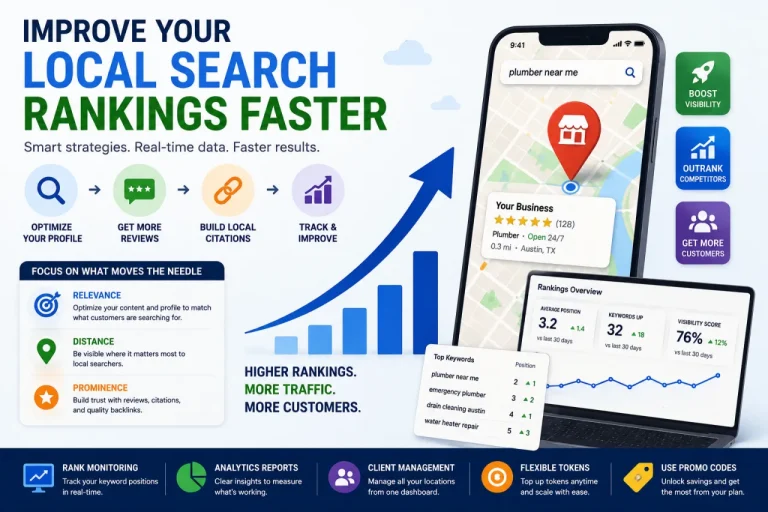
To improve your local search rankings faster, you must first understand the core mechanics that drive the algorithm. Google doesn’t just look at who you are; it looks at how you perform relative to your neighbors and competitors. In the local context, the algorithm weighs three primary factors heavily: Relevance, Proximity, and Prominence. Relevance is how well you match the user’s query. Proximity is how close you are to the searcher. Prominence is how popular your business is.
However, there is a fourth, less discussed factor that significantly impacts velocity: Data Freshness. Search engines prioritize content and data that is current. If your address changed last month, but your website lists the old one, your local search rankings will suffer. To improve your position quickly, you must audit your data for accuracy across all platforms. This starts with your core listing data, specifically your Name, Address, and Phone Number (NAP). If your website says “123 Main St” but your business profile says “125 Main St,” the algorithm gets confused, and your ranking stagnation ensues.
Fixing this is the quickest win in the local search rankings manual. It is often a simple update of contact information. You should perform a site audit immediately to identify these discrepancies. Consistency builds trust signals. When search engines see consistent data, they move you up the ladder faster than when they see conflicting signals.
Key Data Points to Speed Up Your Rankings:
- Core NAP: Ensure your Name, Address, and Phone Number remain identical across all platforms.
- Website Domain: Ensure your domain matches the brand name on your profiles.
- Service Area: Clearly define the zip codes or cities you serve in your metadata.
By cleaning up your foundational data, you create a “strike through” effect on your competitors. It establishes a clear, conflict-free identity for the search engine, allowing it to prioritize you for relevant queries immediately.
Technical Infrastructure for Rapid Crawling
Once your data is clean, you must ensure the search engine can read it. Technical SEO is the backbone of improving local search rankings. A beautiful design means nothing if Google cannot crawl the code behind it. Speed is a ranking factor, not just a user experience factor. Faster loading pages, particularly on mobile, signal to the algorithm that you are ready for high-traffic local demand.
You must implement Local Business schema markup effectively. Schema is the structured data that helps search engines understand the context of your website without needing to guess. It tells them explicitly that you are a “LocalBusiness” operating in “City X.” This is the most effective way to boost local search rankings for map pack results. Without schema, the engine has to infer this from your HTML, which takes longer and is less accurate.
Furthermore, ensure your mobile experience is flawless. The majority of local searches come from smartphones. Users are on the go, waiting for a map result or a phone number. If your site is slow or hard to navigate on a phone, they will bounce, and that behavior is sent back to Google as a negative signal. This impacts how fast they consider you for local search rankings visibility. You need to prioritize mobile-first design.
Mobile-First Schema Checklist
- Business Type: Clearly defined in your code.
- Interaction Data: Add areas of service or opening hours (if applicable).
- Link Structure: Ensure internal links point to the correct landing pages.
By tightening the technical foundation, you reduce the time it takes for Google to index your changes. This reduces the “lag” between your optimization effort and its appearance in search results, accelerating your climb in local search rankings.
Content Strategy to Signal Immediate Relevance
Content signals relevance to the algorithm. But generic content like “We fix cars” is too vague. To improve your local search rankings faster, you need hyper-local content that matches the user’s specific intent. When a user searches, they rarely type their exact city name, but they often omit it, opting for just “Plumbing.” Your content must bridge that gap.
You should create dedicated landing pages for every specific service area you want to dominate. If you serve three neighborhoods, do not try to fit them on one page. Create three distinct pages, each optimized for the specific keywords relevant to that neighborhood. This allows you to target a niche audience without competing against your own homepage. By doing this, you are telling the algorithm exactly who you are serving. This precision improves relevance scores much faster than broad keywords.
You must also answer questions. Local search is heavily driven by voice search and question-based queries. People ask, “Where is the best plumber?” or “Do you offer weekend hours in downtown??” Create blog posts that answer these specific questions. When you cover these queries directly, you earn a spot in “Featured Snippets” and the “People Also Ask” box, which dramatically boosts visibility.
Local Content Tactics:
- Location Pages: Write a specific paragraph about local landmarks for each location.
- Cultural Connection: Mention local sports teams, school districts, or cuisine to show you belong.
- FAQ Pages: Create a list of answers to common local questions.
By focusing on the user, you naturally satisfy the algorithm. When your content directly responds to what your neighbors are asking, you gain local search rankings velocity without expensive ad spend.
Authority Building and Citation Velocity
Authority is the glue that holds rankings together. You build authority through citations, which are mentions of your business on the web. To improve your local search rankings faster, you may not be able to buy them, but you can build them more quickly. A robust presence on key directories is essential.
Google crawls the web for mentions of your business name. The more consistent these mentions are, the more “trusted” you appear. However, not all citations are created equal. High-authority local directories (like the Chamber of Commerce or major industry associations) carry more weight than random blog mentions. You should prioritize your top-tier citations first. If they are missing, adding them immediately provides a short-term boost to your visibility.
Citation velocity is also a signal of growth. When search engines see a pattern of new citations or backlinks appearing, it signals to the algorithm that your business is active and expanding. This can trigger a “freshness” update, potentially lifting your local search rankings. However, do not spam sites. Quality over quantity always wins. A single mention on a reputable local news site is often better than ten on unverified directories.
Strategic Citation Priorities:
- Google Maps: Ensure this is perfect (NAP, photos, hours).
- Yelp and Bing Places: Standard directories that users frequently check.
- Local Associations: Any website listing the city’s approved businesses.
By building a foundation of consistent references, you validate your physical existence to the algorithm. This validation is crucial for moving up local search rankings as quickly as possible.
Leveraging Reviews as Trust Signals
In the local context, social proof is a ranking signal. Google treats new reviews as a signal of business activity and relevance. To improve your local search rankings faster, you need to encourage frequent, positive reviews. A steady stream of new reviews shows the algorithm that the business is active and popular.
Do not just ask for reviews; optimize the process. Use automated emails or SMS to request feedback immediately after a job is completed. Offer incentives if allowed, but always focus on the quality of the feedback. You want detailed reviews that mention specific services. For example, a review saying “I loved the new roof in the south wing” is more valuable than “Great job.”
Manage your reputation actively. If someone leaves a negative review, responding publicly shows you care. This engagement boosts trust not just for the user but for the search engine algorithm as well. Responding to reviews signals that you are monitoring your brand. This interaction level contributes to higher local search rankings because it reduces friction for potential customers who might be hesitating to choose you.
Review Strategy:
- Speed: Reply to reviews within 24 hours.
- Detail: Ask for specific feedback on service quality.
- Volume: A consistent flow of new reviews (e.g., weekly) keeps the profile active.
By optimizing for engagement and feedback, you align your human reputation with your digital ranking performance.
Implementing a Data-Driven Monitoring System
You cannot fix what you do not see. Many businesses struggle to improve local search rankings simply because they are flying blind. They rely on hunches rather than data. To gain speed in your results, you must implement a rigorous monitoring system. This allows you to see fluctuations in real-time and adjust your strategy before minor issues become major setbacks.
Rank monitoring tools provide visibility into the specific keywords driving your local traffic. If you track “Plumber in Austin” and you see a drop from #1 to #5, you know where your local search rankings are slipping. You can then investigate the cause—was it a competitor? A bot crawl? A technical error? This data allows for immediate corrective action. Without a dashboard to track performance, you might miss these opportunities for weeks.
Analytics reports should be actionable. They should not just show “traffic is up.” They should explain why. If your traffic is down, the report should highlight a drop in CTR (Click Through Rate) from a specific region. This granularity helps you focus your local search rankings improvement efforts on the most impactful areas.
Essential Reporting Metrics
- Keyword Position: Where are you for local terms?
- Visibility Heatmap: Do you show up near the top for relevant areas?
- Impressions vs. Clicks: Is visibility driving action or just showing?
By analyzing this data regularly (weekly or bi-weekly), you can pivot your strategy rapidly. This agility is what separates fast-growing local businesses from stagnant ones. It ensures your local search rankings are based on evidence, not assumptions.
Scaling Outreach for Maximum Impact
Finally, if you are an agency or a franchise group, optimizing one location is easy. Scaling that optimization to twenty locations is a headache. To improve your local search rankings faster for multiple sites, you need a scalable workflow. This means standardizing your best practices.
Create a checklist for every business profile. Does it have the right photos? Is the description unique? Are the hours correct? Script a checklist and a set of standard operating procedures (SOPs) for your team to follow. When you scale this checklist, you ensure that every location gets the same high-level attention. This consistency means every client benefits from the same proven strategies for local search rankings.
Additionally, leverage client management systems to delegate tasks. If you have multiple clients, you cannot afford to manually update every link manually. You need a centralized dashboard where all clients are managed in one view. This reduces administrative overhead, allowing you to focus more on high-impact strategy like local search rankings improvements rather than filing.
Conclusion: The Path to Dominance
Improving local search rankings faster is not about cheating the system; it is about working with the signals that search engines use. It requires a disciplined focus on data accuracy, technical excellence, and authentic community engagement. By cleaning your data, optimizing your schema, creating hyper-local content, and monitoring your performance relentlessly, you remove the friction that slows you down.
When you adopt a mindset of continuous improvement, your results will reflect that speed. You move from guessing to knowing. You transition from waiting for results to actively building them. The path to visibility is clear, but it requires the will to execute it today.
You have the blueprint. You understand that technical cleanliness and accurate data are the keys to speeding up your climb. You recognize that reviews and content must be managed with the same precision as code. Now it is time to put this plan into motion.
Get started in seconds. Use a flexible plan that scales with your growth. You can easily manage your account and apply promo codes to streamline your initial set up. Token Top-Ups allow you to scale your discovery process instantly to cover multiple locations or brands. Ensure your business is the first option when the local search engine is queried. Take charge of your growth today and secure your market position.