

How to Analyze Local Search Competition: The Strategic Advantage of Rank Monitoring
When it comes to winning local search, many believe it’s all about optimizing your website, collecting reviews, and maintaining an active business profile. But if you’re not actively analyzing your competition—watching where they shine, where they stumble, and how your position stacks up—you’re missing the formula for breakout success. The heart of that formula is rank monitoring.
Agencies, business owners, and marketing managers are constantly asking: “How do I find my real competitors in local search?” “Which keywords should I watch?” “How do I move up when the competition is stiff?” The answer isn’t a mystery or a guess—it’s rigorous, data-driven rank monitoring.
This comprehensive guide will show you how to analyze local search competition step by step, harnessing the power of rank monitoring to uncover weaknesses in rival strategies, identify new opportunities, and turbocharge your climb up the search results. Let’s dive in.
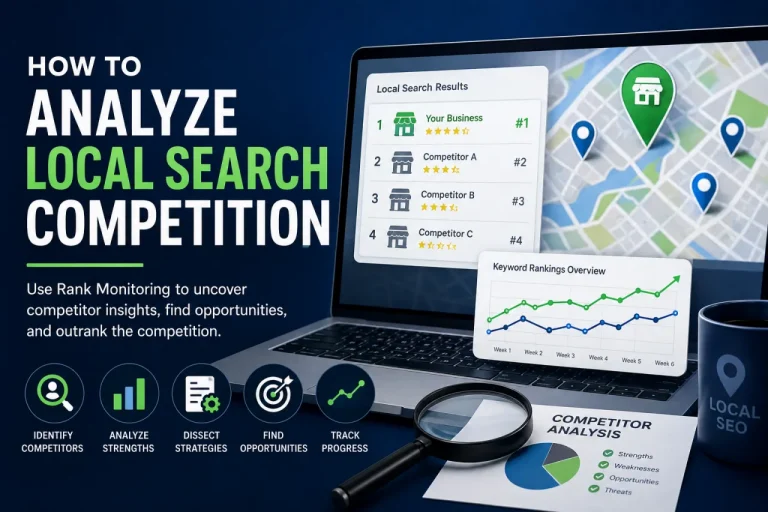
Introduction: The Critical Role of Rank Monitoring in Competitive Local SEO
Imagine walking into a race blindfolded. You start running, but you don’t know where the finish line is, who’s ahead of you, or how fast you need to go to win. This is what optimizing for local search without competitive analysis is like.
Rank monitoring removes the blindfold. It tells you exactly where you stand for the keywords that matter—how those positions change over time, which businesses consistently occupy the top spots, and what tactics move the rankings needle. More than simply measuring your own success, rank monitoring empowers you to make decisions fueled by competitor intelligence, not just hope.
In today’s hyper-competitive local markets, the agencies and brands that employ comprehensive rank monitoring are the ones that don’t just keep up—they leap ahead.
Why Analyzing Local Search Competition Is Essential
Outranking Competition Drives Real Results
- More Traffic and Leads: Almost 70% of all clicks go to the top three local results.
- Better ROI: Targeting the right competitors avoids wasted spend and effort.
- Faster Adaptation: Spotting changes in competitor rankings lets you react before their moves impact your bottom line.
The Pitfalls of Intuitive Guesswork
Too many businesses base their strategy on assumptions: “I think XYZ Pizza is my biggest competitor,” or “We must be number one for this keyword.” In reality, your top local search competitors may be different from competitors in advertising, social, or even foot traffic—and your most valuable keywords might not be what you expect.
Rank monitoring brings clarity and focus. It highlights your most influential search competitors and the search terms that shift your business’s fortunes.
Step 1: Identify Your Local Search Competitors With Rank Monitoring
Before you can analyze or outpace local competitors, you must know who they are—and for what keywords.
How to Identify True Search Competitors
- List Your Core Products or Services: These define your primary keyword targets (e.g., “emergency dentist,” “vegan bakery”).
- Add Key Location Modifiers: Use target city, neighborhood, or “near me” in your searches.
- Search on Google (Incognito): Note which businesses consistently appear in the top results—especially the “map pack” and top 5-10 organic listings.
- Set Up Rank Monitoring: Use a robust tool to automatically track your rankings and your close competitors’ standings for each keyword.
- Update Regularly: Local rankings shift. You must refresh and expand your competitor list seasonally and as new players emerge.
Rank monitoring streamlines the process, highlighting which competitors appear most often and rank highest for your basket of tracked keywords.
Step 2: Analyze Their Strengths and Weaknesses
With your competitors identified, it’s time for a deeper analysis.
Key Elements to Track With Rank Monitoring
- Keyword Positions: Are they always #1, or do they fluctuate?
- Ranking Velocity: Do they improve rankings after new campaigns or updates?
- Seasonal Trends: Do they dominate only during certain times (e.g., holidays, summer)?
- Content & Citations: What keywords, topics, and citations drive their rankings?
- Review Volume and Rating: Are their review strategies stronger or weaker?
Using Rank Monitoring for Insights
- Compare your rankings directly with competitors across every local keyword.
- Spot sudden drops or jumps in their positions—often a sign of new SEO or marketing activity.
- Detect if a new business disrupts the usual top-three, signaling a new local challenge.
By combining keyword tracking with rank monitoring, you have a real-time dashboard of your competitive landscape, not a quarterly or annual snapshot.
Step 3: Dissect Their Optimization Strategies
No two local competitors are the same. Once you know who outperforms you (and for which terms), you can reverse-engineer their success.
What Should You Assess?
- Google Business Profile: Is theirs more complete? More reviews? Regular posts?
- Local Citations: Are they listed in niche directories or have more consistent NAP (Name, Address, Phone) data?
- On-Page Signals: Do their title tags, headers, and page content align with winning keywords?
- Backlink Profile: Do they earn quality local backlinks (from media, organizations, blogs)?
- Content Quality: Are they publishing more robust local content—community events, guides, or case studies?
Rank monitoring, especially when combined with analytics reporting, shows which competitor efforts lead to real ranking shifts. If a rival suddenly surges, you can spot whether it’s review-based, content-driven, or citation-led.
Step 4: Map Opportunities and Threats With Data-Driven Rank Monitoring
Armed with deep competitive data, you can now prioritize your local SEO and marketing investments.
Find Gaps to Exploit
- Keywords You Don’t Rank For: Identify valuable search terms where competitors are present and you’re not—then optimize and monitor with rank tracking.
- Under-Served Locations: If you see high traffic terms in adjacent neighborhoods or suburbs where rivals perform poorly, target those with landing pages, citations, or ad campaigns.
- Content Voids: Spot services, FAQs, or topics your competitors haven’t addressed and fill the gap with high-quality, keyword-optimized resources.
Spot Emerging Threats
- Regular rank monitoring notifications alert you to rapid competitor increases, indicating new marketing pushes.
- Dips in your own rankings can often be correlated with competitors’ positive activities—or unaddressed negative reviews, broken citations, or outdated content on your end.
Step 5: Track Progress With Analytics and Professional Reporting
Rank monitoring doesn’t only reveal where you stand today—it fuels continual improvement with accurate measurement, making it easy to showcase progress to stakeholders or clients.
Benefits of Automated Ranking Analytics
- Visual Reports: See trends and improvements (or declines) over time, tied to specific efforts.
- Keyword Segmentation: Drill down by service, geography, or campaign focus.
- Competitor Benchmarks: Demonstrate distance closed on top rivals, incentivizing clients or teams.
For agencies and multi-location brands, advanced analytics make multi-client or multi-site management seamless. From a single dashboard, you can compare progress, spot trends, and allocate resources based on real data.
Step 6: Leverage Easy Client Management and Scalable Solutions
Whether you’re an agency with 50+ clients or a business owner with several locations, managing local search analysis can be overwhelming—unless you have the right tools.
Efficient Client Management With Rank Monitoring
- Centralized Tracking: Monitor all brands and locations in one interface.
- Permission Controls: Give clients or team members access to their data without risking the entire portfolio.
- Scalable Tracking: Use flexible token top-ups to increase or decrease rank monitoring as your campaigns evolve.
The Power of Promo Codes
Rapidly expand your reporting network by offering promo codes—onboard staff or clients easily, control costs during ramp-up, and show value before seeking additional investment.
Common Pitfalls and Proactive Solutions
Mistake #1: Only Tracking Branded Keywords
You need to monitor not just your business name, but every service, category, and local modifier relevant to your offerings. Don’t let unbranded competition fly under your radar.
Mistake #2: Ignoring Fluctuations in Favor of “Set-and-Forget” Rankings
Local search is dynamic. Regular rank monitoring is essential to catch seasonal swings, algorithm changes, or competitor expansions as they happen.
Mistake #3: Failing to Tie Results Back to Concrete Actions
Always pair your ranking insights with a timeline of your and your competitors’ activities—content launches, citation updates, review campaigns. This allows you to double down on what works and quickly correct what doesn’t.
Advanced: Using Rank Monitoring for Campaign Planning and Budget Allocation
A major advantage of sophisticated rank monitoring is strategic forecasting and allocation.
- Monitor New Keyword Launches: Gauge the impact of new content or service rollouts in near real time.
- Allocate Budget Wisely: Increase investment where rank movement is most promising, reduce spend where competition is fierce and gains are slow.
- Campaign Attribution: Connect ranking jumps to specific efforts—citations, backlinks, reviews, or ad campaigns.
Agencies especially benefit from analytics-driven campaign planning, justifying upsells and renewals with clear, competitive data.
Key Takeaways: Rank Monitoring as Your Competitive Compass
- Rank monitoring is the essential tool for competitive analysis in local search—revealing not just your position, but the whole playing field.
- Competitor insights drive smarter decisions: You’ll know which tactics to pursue, where to innovate, and how to react fast when new threats arise.
- Analytics and reporting turn raw data into actionable opportunities: Celebrate wins, spot losses, and continually optimize your approach.
- Easy management and flexible scaling put you in the driver’s seat, whether managing one brand or hundreds.
Conclusion: Outrun Your Local Competition With Rank Monitoring
Local SEO is never static—the businesses that succeed are the ones who learn, adapt, and move faster than their rivals. Comprehensive, continuous rank monitoring is the difference between wandering blind and racing to the front of the pack with eyes wide open.
Ready to take the guesswork out of local competition? Start today with modern rank monitoring: set up your most valuable keywords, uncover your true rivals, track every ranking move, and transform analytics into growth. Enjoy streamlined client management, intuitive reporting, and scalable tracking with flexible token top-ups designed for agencies and growth-hungry brands.
Uncover your edge, act strategically, and leave the competition behind—start tracking your local search rankings today!