

Introduction: The Three Forces Shaping Every Local Search Result
When someone types “best pizza near me” or “emergency electrician open now” into Google, what determines which businesses appear at the top — and which ones never get seen at all?
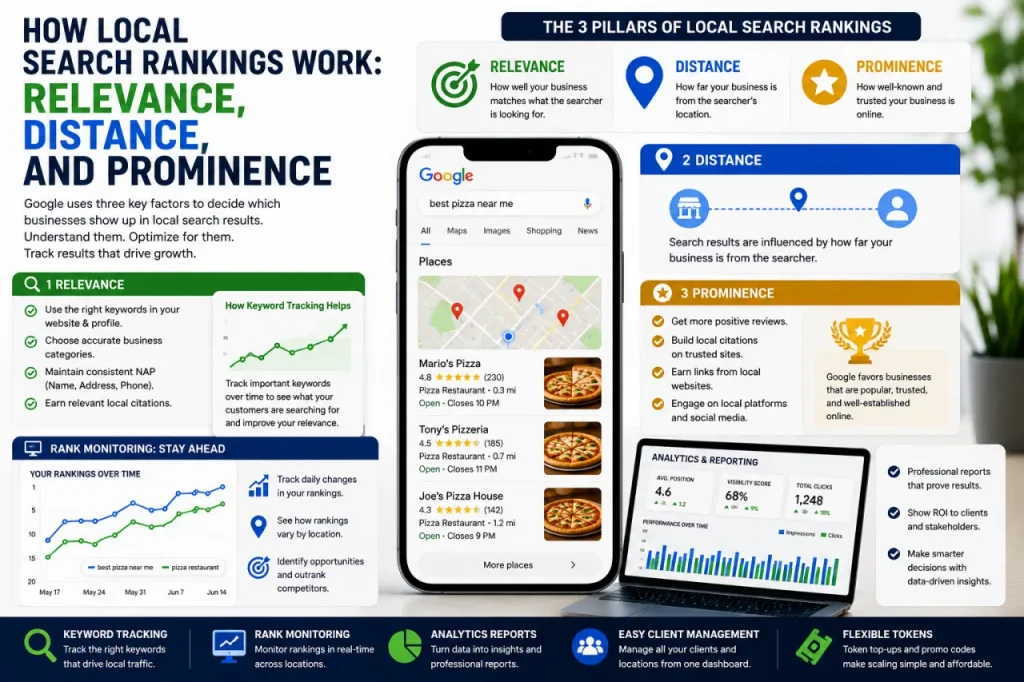
The answer isn’t random. Google uses three core factors to decide local search rankings: relevance, distance, and prominence. Understanding how these three forces interact is the foundation of every effective local SEO strategy.
For business owners, sales professionals, and agency operators, this knowledge isn’t just academic. It’s the difference between building a strategy that produces measurable results and pouring time and budget into tactics that don’t move the needle. When you understand what drives local search rankings, you know exactly where to focus — and you can track whether your efforts are actually paying off.
This article breaks down each of the three ranking factors, explains how they work in practice, and shows you how keyword tracking, rank monitoring, and analytics reporting turn that understanding into a genuine competitive advantage.
What Are Local Search Rankings, and Why Do They Matter?
Local search rankings refer to where a business appears in geographically targeted search results. This includes both the traditional organic results and the local pack — that prominent block of three business listings that appears near the top of a results page for location-based queries.
The local pack is prime real estate. The top local pack positions capture a significant majority of clicks for location-based searches. If your business isn’t appearing there for your most important keywords, you’re missing customers who are actively looking for exactly what you offer.
Local search rankings matter because they connect intent with action. When someone searches locally, they’re typically close to making a decision. They’re not casually browsing — they’re ready to call, visit, or buy. A strong position in local search rankings puts your business directly in front of that high-intent audience at exactly the right moment.
The challenge is that local search rankings are not static. They shift based on competitor activity, algorithm updates, seasonal changes in search behavior, and your own optimization efforts. That’s why ongoing monitoring isn’t optional — it’s essential.
Relevance — Making Sure Google Understands What You Do
Relevance is the first pillar of local search rankings. It measures how closely a business matches what a searcher is looking for. If someone searches “pediatric dentist,” Google wants to surface businesses that are genuinely and specifically pediatric dentists — not general dental practices that occasionally serve children.
How Google Assesses Relevance
Google builds its understanding of your business from multiple signals — the categories associated with your listing, the language used across your web presence, the keywords your content targets, and how consistently your business information appears across the web.
The key word there is consistency. Google cross-references your business information from many sources. When those sources align and reinforce the same clear message about what your business does, Google’s confidence in its understanding of you increases — and so does your relevance score for related searches.
Relevance is not a one-time setup. It’s a living signal that needs ongoing attention. New competitors enter the market. Search behavior shifts. The language customers use to find your type of business evolves. Keeping your relevance signals current is an ongoing commitment, not a box you check once.
How Keyword Tracking Improves Relevance
This is where keyword tracking becomes a strategic tool rather than just a reporting exercise. By monitoring specific search terms over time, you can see which keywords are generating impressions and which ones are gaining or losing traction for your business category.
If you run a law firm and you notice that searches for “personal injury attorney” are rising while searches for “accident lawyer” are plateauing, that’s a relevance signal. Your content and messaging should reflect the language your market is actually using. Keyword tracking gives you that real-time intelligence so you can stay ahead of the shift rather than react to it after the fact.
For agency owners managing multiple business clients, this is particularly valuable. You can track keyword relevance trends across every client account from a single dashboard, spotting opportunities and threats before they show up in the revenue numbers.
Distance — How Proximity Shapes Local Search Rankings
Distance is the second major factor in local search rankings. Google factors in how far each potential result is from the location term used in a search — or from the searcher’s detected location if no specific location is mentioned.
Understanding How Distance Actually Works
Distance might seem straightforward — closer businesses rank higher — but the reality is more nuanced. Google doesn’t simply rank the nearest business at the top. It weighs distance against the other two factors. A business that’s slightly farther away but significantly more relevant and prominent can still outrank a closer competitor.
This is important because it means distance is the one ranking factor you have the least direct control over. You can’t move your business to be physically closer to every searcher. What you can do is strengthen your relevance and prominence to compensate for any distance disadvantage you might have.
Using Rank Monitoring to Track Distance-Based Ranking Variations
Here’s something that surprises many business owners: your local search rankings are not the same for every searcher, even those searching for the same keyword. A person searching from two blocks away from your business may see a very different result than someone searching from across town.
Rank monitoring gives you real-time visibility into where your business stands in search results — and tracking those positions over time reveals patterns that pure gut instinct would never catch. You can see how your rankings fluctuate based on time of day, day of week, and competitive changes, giving you a data foundation to make smarter optimization decisions.
For sales professionals pitching local SEO services to potential clients, this is a powerful demonstration. Showing a prospect exactly where they currently rank — and where they could rank with the right strategy — turns an abstract conversation into a concrete, compelling case.
Strengthen Your Local Presence with Local Search Optimization
Local search and its optimization aren’t just nice-to-have: they’re essential for any business looking to grow its customer base within a particular area. By using the right keywords, ensuring NAP consistency, optimizing directory profiles, and leveraging keyword tracking software and daily rank tracking tools, you can reach more customers at the moment they’re ready to buy.
Ready to track and improve your local search performance? Start your free account with Rankscout—the best keyword rank tracker with automated rank position, daily rank tracking software, and keyword ranking report software. Top up your tokens today, and see how local search optimization can move your business to the top of local results!