

Introduction
A business does not need to disappear from local search results to begin losing customers. Its website might continue ranking for important keywords, maintain familiar positions, and appear to have a stable online presence. Yet beneath those seemingly positive results, the effectiveness of its search visibility may already be weakening. Fewer people might be clicking through to the website, competitors may be attracting more attention, or customer demand may be shifting toward searches the business has not adequately addressed.
This gradual decline creates a challenge for business owners and SEO professionals because traditional ranking measurements do not always reveal the full picture. A company can maintain the same position for a keyword while receiving fewer visitors or generating fewer inquiries. Without examining the relationship between rankings, customer behavior, and market conditions, the business may assume its SEO strategy remains healthy simply because its positions have not changed significantly.
This process can be understood through local search visibility decay, a concept describing the gradual reduction in the practical value of a business’s search presence. Rather than focusing exclusively on whether rankings rise or fall, it examines whether existing visibility continues to create meaningful opportunities for customer discovery and engagement.
Local search visibility decay is not an official search engine ranking factor or a standardized SEO metric. It is a framework for recognizing when search performance begins losing effectiveness before obvious ranking declines occur. Understanding this distinction helps businesses identify early warning signs, respond to changing customer demand, and make better decisions about maintaining their online presence.
For companies that depend on local customers, recognizing visibility decay can be especially valuable. It encourages a more complete approach to SEO performance, where rankings are considered alongside search demand, customer intent, competitive activity, and the quality of the website experience.
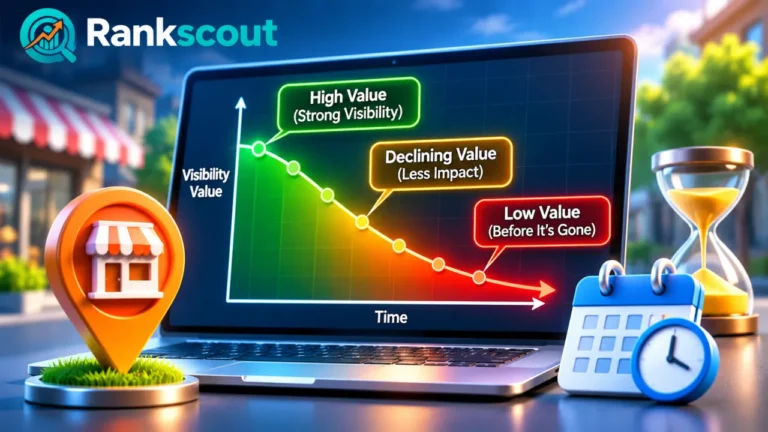
Understanding the Local Search Visibility Decay Curve
The local search visibility decay curve describes how the value of established search visibility can weaken gradually over time. Although the term suggests a predictable pattern, the decline does not necessarily follow a fixed mathematical curve. Some businesses experience slow changes over several months, while others encounter sharper shifts caused by competition, customer demand, or changes in search results.
Consider a home improvement company that has maintained strong rankings for general renovation services. Its website continues appearing prominently for familiar searches, but fewer visitors are requesting estimates. At first, the company may attribute this change to seasonal conditions or normal fluctuations. However, closer examination could reveal that customers increasingly search for specific renovation services, energy-efficient upgrades, or specialist solutions that the website does not adequately explain.
The company’s established rankings have not necessarily disappeared. Instead, the searches generating those rankings may represent a smaller or less commercially valuable portion of the market.
Another business might experience visibility decay because competitors have improved their website content and become more attractive options for potential customers. Even when the original business maintains a similar ranking position, competing results may communicate their services more clearly or provide information that better matches customer expectations.
These examples illustrate why local search visibility decay should be evaluated through multiple indicators. Rankings remain useful, but they cannot independently explain whether a business is maintaining its ability to attract relevant customers.
The objective is to recognize changes in the effectiveness of search visibility before they develop into more serious performance problems.
Why Stable Rankings Can Hide Declining Search Performance
Stable rankings are often interpreted as evidence that a local SEO strategy is working. If a business continues appearing in similar positions for its important keywords, it may assume that its online presence remains competitive.
However, ranking stability does not guarantee stable customer demand.
Search volume can change because of seasonality, economic conditions, evolving consumer preferences, or shifts in the services customers need. A keyword that previously attracted substantial interest may become less valuable even when a business maintains its position.
For example, a company specializing in traditional heating systems might rank consistently for established service terms while customer interest gradually shifts toward newer heating technologies. The business could maintain strong positions for its existing keywords while missing opportunities associated with changing customer priorities.
Search result presentation can also influence performance. Different result features, competing listings, and the way information appears on the results page can affect whether users choose to visit a website. A business may remain visible without receiving the same level of attention it previously enjoyed.
Another possibility is that the website no longer meets customer expectations as effectively as competing pages. Visitors might arrive through search but leave because the information is outdated, unclear, or difficult to navigate.
These situations demonstrate that local search visibility decay can occur without dramatic ranking movements.
Businesses should therefore examine whether their existing visibility continues to attract relevant visitors and generate useful inquiries. A stable position is valuable, but its commercial importance depends on the demand and behavior associated with that search.
The Relationship Between Customer Demand and Local Search Visibility Decay
Customer demand is one of the most important influences on the long-term value of local search rankings. Businesses often build their keyword strategies around the services and search patterns that are popular at a particular point in time. However, customer needs are not fixed, and the language people use to describe those needs can evolve.
A service category may become more specialized as customers gain access to new products, technologies, or information. Searches that once relied on broad industry terms may gradually shift toward more specific problems and solutions.
For example, a home security company might initially attract customers through general searches for security system installation. Over time, potential customers may increasingly research particular types of monitoring equipment, installation requirements, or integration with existing home technology.
If the company’s website continues concentrating almost entirely on broad service terms, its visibility may become less representative of the demand available in the market.
Local search visibility decay can also result from changes in purchasing behavior. Customers may spend longer researching services, compare more providers, or prioritize different factors when making decisions. A website that previously answered common questions may no longer provide enough information to satisfy these expectations.
Businesses can respond by reviewing the relationship between their keyword priorities and current customer needs. Sales conversations, service inquiries, and recurring questions can reveal whether the market is changing in ways that existing website content does not reflect.
The goal is not to abandon established keywords whenever demand shifts. Instead, companies should maintain valuable search coverage while identifying emerging needs that deserve attention.
Recognizing the Early Warning Signs of Visibility Decay
Local search visibility decay often becomes easier to address when businesses recognize its early warning signs. One potential indicator is a sustained reduction in search-driven website visits despite relatively stable rankings. This pattern suggests that the issue may involve search demand, result presentation, or changes in user behavior rather than a straightforward loss of ranking positions.
Another warning sign is declining engagement with important service pages. If visitors increasingly leave without exploring relevant information or taking useful actions, the website may no longer meet their expectations as effectively as it once did. However, engagement data should be interpreted carefully because a short visit can sometimes indicate that a customer quickly found the information they needed.
Changes in inquiry quality can also reveal underlying problems. A business may continue receiving similar numbers of visitors while attracting fewer customers who are interested in its most profitable services. This could indicate that its keyword visibility is becoming less aligned with commercial priorities.
A further signal is growing dependence on a narrow collection of older keywords. If the business’s search strategy has remained largely unchanged while its services or customer market have evolved, important opportunities may be developing outside its existing keyword coverage.
Competitive changes deserve attention as well. When other businesses introduce clearer service information or more useful content, they may become more attractive options even before major ranking shifts occur.
No single warning sign proves that local search visibility decay is taking place. Businesses should look for repeated patterns across several indicators and investigate possible explanations before making significant changes.
How Outdated Website Content Accelerates Local Search Visibility Decay
Website content can gradually lose relevance when it no longer reflects the services, questions, and expectations of current customers. A page that was useful when originally published may become less effective if important details change or competing websites provide more complete information.
This does not mean every page needs constant rewriting. Content that accurately explains an established service can remain useful for years. Problems arise when businesses stop reviewing whether their information still meets customer needs.
A roofing company, for example, might have a service page that describes general roof repairs but does not address newer materials, common inspection questions, or the practical concerns customers raise during consultations. The page may continue ranking, yet visitors could find competing websites more helpful when comparing providers.
Outdated information can also create uncertainty. Incorrect service coverage, unclear availability, or descriptions of services the business no longer offers can discourage potential customers from making contact.
Maintaining content relevance requires periodic evaluation rather than unnecessary expansion. Businesses should review important pages to determine whether their explanations remain accurate, whether common customer questions are answered, and whether the information is easy to understand.
Improving existing content can sometimes provide greater value than publishing additional articles. A clear, comprehensive service page may support customer decisions more effectively than several short pages covering closely related topics.
By maintaining the usefulness of established content, businesses can reduce one potential source of local search visibility decay while preserving the strengths of their existing online presence.
Competitive Pressure and the Gradual Erosion of Search Value
Local search competition changes continuously. New businesses enter markets, established companies expand their services, and competitors invest in improving their websites. These developments can influence the value of existing search positions even when rankings do not immediately change.
A business may maintain a familiar position while competitors become more effective at communicating their services. Clearer page titles, more relevant information, and stronger explanations of customer benefits can influence which result a potential customer chooses to explore.
Competition can also reveal changes in the market. If several providers begin developing content around a particular service or customer problem, that activity may indicate an opportunity worth investigating. However, competitor behavior should not be treated as proof of customer demand without additional evidence.
Local search visibility decay becomes more likely when businesses assume that established rankings will remain commercially valuable without further attention. A website that once offered the clearest information may gradually become less competitive as other companies improve.
The appropriate response is not to copy every competitor or react to every minor ranking movement. Businesses should examine whether competing websites address customer needs more effectively and identify improvements that support their own strengths.
This might involve explaining specialist services more clearly, improving website navigation, or providing practical information that helps customers compare options.
A resilient competitive strategy focuses on maintaining relevance and usefulness rather than pursuing constant changes for their own sake.
Geographic Changes and Their Effect on Local Search Visibility
Geographic demand can change as communities develop, populations shift, and businesses expand or reduce their service areas. These changes can influence the commercial value of local search visibility even when a company’s ranking positions remain relatively stable.
A contractor might have strong visibility in an established neighborhood but discover that much of the new demand for its services is emerging in nearby developments. If its online presence remains focused entirely on its original market, the business may miss opportunities to reach customers in areas it can already serve.
Other geographic changes can have the opposite effect. A location that previously generated profitable inquiries may become less attractive because of stronger competition, longer travel requirements, or changes in customer demand.
Local search visibility decay should therefore be evaluated in the context of actual service coverage and market opportunity.
Businesses should review whether their website accurately communicates the locations they serve and whether important services are relevant to the communities they want to reach.
However, expanding geographic content should not become an exercise in creating repetitive pages for every nearby town. Location-specific information should provide genuine value and reflect the company’s operational capabilities.
The objective is to ensure that geographic visibility remains connected to realistic customer opportunities rather than maintaining search coverage that no longer supports business priorities.
Measuring Local Search Visibility Decay With Greater Accuracy
Understanding local search visibility decay requires comparing ranking performance with other indicators of customer discovery. Businesses should begin by establishing a consistent set of important keywords and organizing them according to service relevance and commercial value.
Tracking these searches over time provides a foundation for understanding whether visibility is genuinely changing. However, ranking movements should be considered alongside search impressions, website visits, and relevant customer inquiries where reliable data is available.
If rankings remain stable while impressions decline, the business may be experiencing reduced search demand or changes in how often its pages appear for relevant searches. If impressions remain steady but website visits decrease, the business may need to examine how its results compete for attention.
When traffic remains stable but inquiries decline, the problem may involve customer intent, website usability, service information, or other factors affecting the decision to make contact.
These patterns provide useful starting points for investigation, but they do not establish causes automatically. Businesses should consider seasonality, broader market conditions, and changes in other marketing activities before drawing conclusions.
Comparisons should also use meaningful time periods. A seasonal business may experience predictable fluctuations that are unrelated to long-term visibility decay. Comparing similar periods across different years can sometimes provide a clearer picture than comparing consecutive months.
The objective is to understand whether the business’s existing search presence continues to support its commercial goals.
Preventing Visibility Decay Through Consistent SEO Maintenance
Preventing local search visibility decay does not require businesses to constantly redesign their websites or rewrite every page. A more effective approach involves regular evaluation and targeted improvements based on evidence.
Important service pages should be reviewed periodically to ensure that information remains accurate and useful. Businesses can examine whether customer questions have changed, whether new services need clearer explanations, and whether visitors can easily find the information required to make a decision.
Keyword priorities should also be reassessed as the business evolves. A company that introduces new services or begins serving different customer groups may need to expand its search coverage to reflect those changes.
Performance reviews can help identify whether established keyword categories remain valuable. If a search consistently attracts relevant customers, maintaining that visibility may be a sensible priority. If its commercial contribution appears to be declining, further investigation may reveal whether demand has changed or whether the website needs improvement.
Businesses should avoid making large changes solely because of temporary fluctuations. Search performance naturally varies, and unnecessary intervention can make it harder to understand which actions are beneficial.
A consistent maintenance process allows companies to protect established strengths while responding to meaningful developments in their market.
Turning Early Visibility Decline Into New Growth Opportunities
Although local search visibility decay can indicate weakening performance, it can also reveal opportunities for improvement. A decline in the effectiveness of established keywords may encourage businesses to examine customer needs they have previously overlooked.
For example, a company might discover that general service searches are becoming less valuable while more specific customer questions are attracting growing interest. This could justify developing clearer information around specialist services or common problems.
Another business may find that its website attracts visitors but does not explain its services in enough detail to encourage inquiries. Improving the customer experience could help the company make better use of its existing visibility without requiring substantial ranking increases.
The most useful opportunities depend on the cause of the decline. If demand has shifted, keyword priorities may need adjustment. If competitors provide more relevant information, existing content may require improvement. If the website creates unnecessary friction, usability and clarity may deserve attention.
Businesses should prioritize changes according to their likely commercial value rather than simply pursuing the largest possible increase in traffic.
By treating declining performance as a source of information, companies can make more informed decisions and develop a search strategy that remains aligned with changing market conditions.
Conclusion
Local search rankings can remain stable while their commercial value gradually declines. A business may continue appearing for familiar keywords but attract fewer relevant visitors, generate weaker inquiries, or miss emerging customer demand.
Local search visibility decay provides a useful framework for recognizing this problem before it becomes a more obvious loss of search performance.
By examining customer demand, website content, competitive conditions, geographic relevance, and performance trends, businesses can develop a clearer understanding of whether their existing visibility continues to create meaningful opportunities.
The solution is not to make constant changes or abandon successful keywords. Instead, companies should maintain useful content, reassess their priorities when market conditions change, and evaluate search performance alongside real customer outcomes.
Sustainable local SEO depends on more than holding ranking positions. It requires ensuring that those positions remain relevant to the customers a business wants to reach.
When companies recognize the early signs of declining search effectiveness, they can respond with focused improvements and protect the long-term value of their online presence.
Understanding how your search rankings change over time can help you identify important shifts before they become larger performance problems.
Rankscout helps businesses and SEO professionals track keywords, monitor search rankings, and use analytics reports to understand visibility trends. By following the searches that matter to your business, you can recognize meaningful changes and make more informed decisions about your local SEO priorities.
Ready to gain a clearer understanding of your search performance? Visit Rankscout.app and start tracking the rankings that support your long-term growth.