

Introduction
A business can have a strong website, an established local presence, and years of experience in its industry and still struggle to turn that strength into meaningful search visibility. One reason is that local search does not always reflect a business in the same structure that the business uses internally. A company may think in terms of departments, service packages, customer types, locations, and revenue streams, while customers search using a mixture of problems, services, descriptions, questions, and local terms. When those two structures do not connect clearly, search visibility can become fragmented. Some services may receive strong exposure while others remain difficult to discover, and important areas of the business can become buried beneath broader or less valuable searches. Local search service architecture provides a way to think about this problem by organizing a business’s search presence around the services it actually wants customers to find.
Local search service architecture is not about creating as many service pages or targeting as many keywords as possible. It is about creating a logical relationship between what a business offers, what customers search for, and how those searches connect to the business as a whole. A company with ten different services should not necessarily treat those services as ten completely separate SEO projects. There may be groups of related searches, overlapping customer needs, and different levels of commercial importance that need to be understood together. At the same time, treating everything as one broad category can make it difficult for search engines and customers to understand the specific areas in which the business provides value. The objective is to create a clear structure where individual services can build visibility while still contributing to a larger local search presence.
What Is Local Search Service Architecture?
Local search service architecture describes the way a business organizes its services, search topics, and local visibility so that they form a coherent structure rather than a collection of disconnected ranking targets. Every business has some form of service architecture, even if it has never formally defined one. A plumber may separate emergency repairs, installations, maintenance, and specialized systems. A law firm may have several practice areas with different customer needs and search behavior. A marketing agency may provide SEO, paid advertising, content, web development, and consulting. A healthcare provider may offer several types of appointments or treatments. The way these services are presented online influences how customers discover the business and how search engines understand what the business provides.
The challenge is that customers do not always use the same terminology as the business. An internal service name may be accurate but rarely searched, while customers may use a more familiar description of the same service. Other searches may describe the problem rather than the solution. Someone looking for a heating company, for example, may search for a specific repair, a general service, an emergency solution, or a symptom of a problem. A useful local search service architecture needs to account for these differences without turning every variation into a separate and repetitive target. The goal is to establish relationships between search terms and services so that the business can build meaningful visibility across the different ways customers discover what it offers.
Why Service Structure Matters in Local Search
Search visibility becomes easier to manage when a business understands which services sit at the center of its local search strategy. Without that structure, keyword lists can become large and difficult to interpret. One service may have dozens of related searches while another has only a handful, but the number of keywords does not necessarily indicate the importance of either service. Similarly, a business might rank well for broad searches while remaining difficult to find for specific services that generate higher-value customers. Looking at search performance through the structure of the business makes these differences easier to recognize.
A clear service structure also helps prevent a common problem in local SEO: allowing the most established part of a business to dominate the entire search strategy. Older services often have more history, more content, and more existing visibility, so they can naturally appear stronger in performance reports. Newer services may be strategically important but have not had the same opportunity to develop. If every keyword is evaluated together, the established service can make the overall picture look healthy even while another important part of the business remains underrepresented. Local search service architecture creates a way to separate those areas and evaluate them according to their actual role in the business.
This becomes especially important for businesses that have expanded over time. A company may have started with one core service and gradually added additional offerings as customer demand changed. Its website, content, and search presence may still reflect the original structure even though its current business model is much broader. When that happens, search visibility can lag behind business development. The company may have evolved commercially without building an equally clear search structure around that evolution. Understanding the architecture of its services provides a starting point for closing that gap.
Building Local Search Service Architecture Around Customer Needs
The strongest service structures begin with customer needs rather than internal terminology. A business naturally thinks about what it sells, but customers usually begin with what they need to accomplish, fix, understand, or purchase. Those two perspectives often overlap, but they are not always identical. A company might describe a service using a technical term while customers search using a problem or outcome. Local search service architecture needs to bridge that difference so that the business can be found through the language people actually use.
This does not mean replacing professional terminology with generic keywords. Instead, it means understanding the different layers that can exist around a service. At the center is the actual service the company provides. Around that service are searches describing the problem, desired outcome, type of solution, urgency, product or system involved, and local context. Some customers may already know exactly what they need, while others may only understand the problem they are experiencing. A strong search structure gives the business an opportunity to be discovered at different points without losing the connection between those searches and the underlying service.
For example, an electrical company may provide panel upgrades as a specific service, but potential customers might search for electrical panel replacement, outdated electrical panel help, breaker problems, electrical safety upgrades, or related local terms. These searches should not automatically become separate pages simply because the wording is different. Instead, the business can analyze how those searches relate to the same underlying service and determine where a unified service structure makes sense. This produces a more natural search presence while reducing the temptation to create thin or repetitive content simply to target additional phrases.
Connecting Services With Local Search Behavior
Location adds another dimension to service architecture because the same service can generate different search behavior depending on where the customer is located and how the business operates. A company serving one city may have a relatively simple local structure, while a company covering several communities may need to understand how its services and markets intersect. The objective should not be to create an artificial version of the business for every possible location. Instead, businesses should understand which combinations of service and location represent genuine parts of their market.
This is particularly important for companies with different service priorities in different areas. A business might provide the same core services across a region but see stronger demand for certain offerings in particular communities. Another company may be expanding into a new area and need to develop visibility around its most important services there. These differences can become difficult to see when all rankings are grouped into one overall performance figure. A structured approach makes it easier to understand where each service fits within the broader local market.
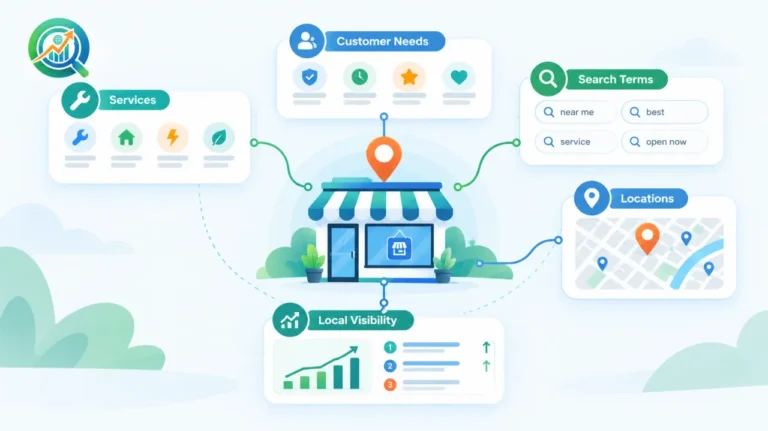
Local search service architecture therefore benefits from thinking in terms of relationships rather than isolated pages or keywords. A service connects to customer needs. Customer needs connect to search behavior. Search behavior connects to locations. Those locations connect to the areas where the business operates and wants to grow. When these relationships are understood, the resulting search strategy becomes easier to organize because every target has a reason for existing. Instead of asking whether a business should target another keyword, the better question becomes whether that search represents a meaningful part of the service and market structure.
Avoiding a Search Strategy Built Around Keywords Alone
Keywords are essential to understanding local search, but a keyword list is not the same thing as a strategy. A list tells a business what people search for, but it does not necessarily explain how those searches relate to one another. Without that context, businesses can end up chasing individual phrases simply because they appear to have attractive search volume or because competitors rank for them. This can create a scattered strategy in which every keyword becomes its own priority and the larger structure of the business becomes harder to see.
Local search service architecture provides a different way to organize the same information. Rather than starting with hundreds of individual phrases, businesses can begin with their most important services and then map relevant searches around those services. This allows related keywords to be considered together and makes it easier to identify whether a service has sufficient search coverage. It also helps distinguish between variations that belong together and genuinely different customer needs that may deserve separate attention.
This approach can make SEO planning more efficient because it encourages businesses to prioritize relationships over volume. A service with twenty closely related search phrases may not require twenty separate pieces of content. Conversely, a service with several distinct customer needs may require more detailed coverage even if its keyword list is smaller. The architecture provides the context needed to make those decisions. It turns keyword research from a collection exercise into a way of understanding how customers look for the services a business provides.
Finding Weak Points in Your Service Architecture
Once services and searches are organized into a clear structure, weaknesses become easier to identify. A business might discover that one service has extensive visibility while another has very little. It may find that its primary location is well represented while another important market is barely visible. It may also discover that customers use several different search patterns to find a service, but the business has built its search presence around only one of them. These gaps are useful because they show where the structure of search visibility does not yet match the structure of the business.
Not every gap needs to become an immediate SEO project. Prioritization still matters. A small service with limited commercial importance may not justify the same level of attention as a core offering that the business wants to expand. This is why service architecture should always be connected to business objectives. The purpose is not to create perfect symmetry across every service. The purpose is to make sure the business understands where its search presence is strong, where it is weak, and which weaknesses actually matter.
Businesses should also look for structural weaknesses rather than focusing only on individual rankings. If ten related searches for one service all perform poorly, the problem may be broader than a single keyword. If one service performs strongly across several related searches, that may indicate that the business has developed a well-established presence around that category. Patterns like these are more informative than isolated ranking movements because they reveal how visibility is distributed throughout the service structure.
Keeping Local Search Service Architecture Flexible
A useful architecture should provide structure without becoming rigid. Businesses change, and their search strategies need to change with them. New services appear, old services become less important, customer behavior evolves, and companies enter or leave markets. A structure that cannot accommodate those changes will eventually become outdated. The answer is not to rebuild the entire strategy every time something changes, but to maintain a clear framework that can absorb new priorities.
This is where regular evaluation becomes important. Businesses can periodically review their main service categories, the searches associated with them, and the markets in which they want to compete. They can then compare that structure with current search visibility to see whether the two still match. If a new service has become strategically important, it should be represented in the search structure. If a service has become less relevant, its role can be reconsidered. If a new market has become important, the relationship between that market and the company’s services can be evaluated.
Flexibility also means avoiding excessive complexity. A service architecture should make search performance easier to understand, not create another layer of administrative work. The best structures are usually intuitive enough that a business owner, marketing team, or SEO professional can look at the major service categories and quickly understand what each one represents. When the structure is clear, it becomes much easier to communicate priorities and decide where search visibility deserves attention.
Measuring Whether Your Search Structure Is Working
Measurement should focus on whether the architecture is helping the business understand and improve its visibility rather than simply counting the number of keywords being tracked. Businesses can look at performance across service groups, compare important categories, examine changes over time, and identify whether visibility is becoming more balanced around their strategic priorities. This does not mean every service should rank equally. It means the business should have a clear explanation for why its visibility is distributed the way it is.
One useful approach is to establish a starting picture of the business’s service structure and then observe how it changes over time. Which services are gaining visibility? Which remain stable? Which are consistently difficult to find? Are improvements concentrated in established areas, or are newer priorities beginning to develop? Are certain locations becoming stronger for particular services? These questions provide more useful context than a single overall ranking number because they connect search performance to the structure of the company.
The same framework can also improve reporting and decision-making. When performance is grouped by meaningful service categories, business owners can more easily understand what their search activity is accomplishing. An agency can explain why certain areas received attention and what changed afterward. Sales teams can connect SEO discussions to actual services instead of presenting a long list of technical metrics. Most importantly, everyone involved can work from the same understanding of what the search strategy is designed to achieve.
Local Search Service Architecture and Long-Term Growth
As businesses grow, their search presence often needs to become more sophisticated. A small company with one primary service may only need a relatively simple structure. A larger business with several service categories, multiple markets, and different customer groups needs a way to prevent all of that information from becoming disconnected. Local search service architecture provides a framework for scaling visibility without losing sight of what the business actually does.
The value of this approach becomes particularly clear when a business wants to expand. Expansion can mean adding services, entering new communities, targeting different customer groups, or increasing demand for an existing offering. Each form of expansion creates new search considerations. Without a structured approach, businesses can add keywords and pages without knowing how they fit into the existing presence. With a clear architecture, new priorities can be evaluated against the current structure and incorporated where they make sense.
Long-term growth also requires businesses to protect what is already working. A search strategy focused entirely on new opportunities can overlook important established services that continue to generate value. Architecture helps balance expansion with maintenance because it makes the full service structure visible. Businesses can identify the areas that need development while continuing to pay attention to the categories that support existing demand. This creates a more sustainable approach in which search visibility grows without becoming disconnected from the foundation of the business.
Creating a More Coherent Local Search Presence
The ultimate purpose of local search service architecture is coherence. Customers should be able to discover a business through the services and problems that genuinely matter to them, while the business should be able to understand how those searches connect to its commercial priorities. Search engines should also have a clear picture of the subjects, services, and markets associated with the business. When these elements are aligned, local search becomes easier to manage because the underlying structure makes sense.
A coherent presence does not require a business to rank for every variation of every search. It requires a deliberate relationship between services, customer needs, locations, and search topics. That relationship provides a framework for deciding what deserves attention and what does not. It also creates a stronger foundation for future changes because the business can add new priorities without abandoning the structure that already exists.
Businesses that take this approach can begin to view local SEO differently. Instead of asking only, “What keywords should we rank for?” they can ask, “How should our search presence represent the business we are building?” That question leads to more useful discussions about services, markets, customer behavior, and commercial priorities. It also makes ranking data more meaningful because every ranking has a place within a larger structure.
Conclusion
Local search service architecture gives businesses a practical way to connect their search presence with the services they actually sell. Rather than treating keywords as isolated targets, it organizes them around meaningful service categories, customer needs, locations, and business priorities. This makes it easier to identify gaps, understand strengths, prioritize opportunities, and recognize when search visibility no longer reflects the direction of the company.
The goal is not to create the largest possible collection of ranking keywords. It is to build a search presence that makes sense. When the structure of local search reflects the structure of the business, ranking data becomes easier to interpret and SEO decisions become more closely connected to commercial objectives. Businesses can protect established services, develop newer priorities, understand differences between markets, and create a clearer path for future growth. In an increasingly competitive local search environment, that kind of structure can provide the foundation for a more focused and sustainable search strategy.
Once your search strategy is structured around the services and markets that matter, having reliable performance data makes it easier to understand what is changing. Rankscout gives businesses and agencies tools for Keyword Tracking, Rank Monitoring, and Analytics so they can follow important search terms, monitor ranking performance, and turn search data into clearer insights. Client Management also helps keep multiple business accounts organized, while Tokens and Promo Codes provide flexibility as tracking requirements change. If you want a simpler way to monitor local search performance and understand how your visibility develops over time, get started with Rankscout and put your search data to work.