

Introduction
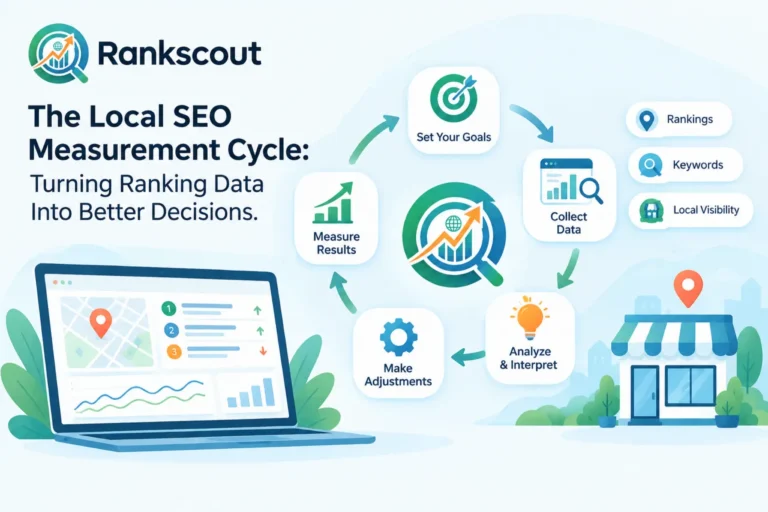
Local SEO can generate a tremendous amount of data, but data alone does not create better search performance. Businesses can collect ranking positions, monitor keywords, compare competitors, and review changes over time, yet still struggle to understand what those numbers actually mean. The problem is often not a lack of information but a lack of structure. When ranking data is viewed as a collection of isolated numbers, it becomes easy to focus on small changes while missing the larger patterns that can influence a local search strategy. Effective local SEO measurement takes a different approach. It creates a continuous cycle in which businesses establish what they want to measure, collect consistent information, interpret what has changed, make informed adjustments, and then measure the results again. This turns ranking data from a passive report into an active part of the decision-making process.
The idea of a measurement cycle is particularly useful because local search performance is not static. A business can change its services, enter a new market, face new competitors, publish new content, or respond to changing customer behavior. At the same time, the searches people use can change as their needs evolve. A ranking that looked strong six months ago may no longer tell the full story, while a service that was previously a small part of the business may become increasingly important. Without regular measurement, these changes can be difficult to identify. With a structured approach to local SEO measurement, businesses can build a historical view of their search performance and use that information to make decisions based on evidence rather than assumptions.
The most effective measurement process is therefore not about checking rankings as frequently as possible or trying to make every number increase. It is about knowing what matters, measuring it consistently, understanding the context around the results, and using what has been learned to guide the next stage of the strategy. Local SEO measurement works best as a cycle rather than a final reporting step. Once that cycle is established, every measurement period becomes an opportunity to learn something about the business, its customers, and the local search environment.
What Is Local SEO Measurement?
Local SEO measurement is the process of tracking, evaluating, and interpreting search performance to understand how effectively a business is being discovered through local search. This can include monitoring rankings for important keywords, examining changes across services and locations, identifying patterns in search visibility, and comparing current performance with historical results. The purpose is not simply to record where a business ranks but to understand whether its search presence is moving in a direction that supports its wider business objectives.
A useful measurement process begins with relevance. Businesses need to identify the searches that genuinely represent their services, products, locations, and customers before they can draw meaningful conclusions from ranking data. A company with several services may need to measure each major category rather than relying on one broad keyword. A business operating across several locations may need to examine how rankings differ from one market to another. Similarly, businesses may want to distinguish between searches that indicate research and searches that suggest a customer is actively looking for a provider. The more closely the measurement framework reflects the actual business, the more useful the resulting data becomes.
This is why the objective should not be to measure everything. Good local SEO measurement is selective as well as consistent. Tracking hundreds of unrelated terms can create an impressive dataset without producing useful insight. A smaller collection of carefully chosen searches can often provide a clearer picture when those searches represent the services, locations, and customer needs that matter most.
Building a Local SEO Measurement Framework
Before businesses can measure improvement, they need to establish what improvement means. This sounds obvious, but it is easy to begin tracking rankings without defining the purpose behind the measurement. A local business might monitor twenty keywords because they are commonly associated with its industry, but if those terms do not reflect its most important services or customers, the resulting report may not help the business make better decisions. The first stage of a strong local SEO measurement framework is therefore to connect search terms with real business priorities.
Keywords can be organized into useful groups based on service, location, customer need, and intent. For example, a home services company might separate searches into plumbing, heating, electrical, and emergency services. A business with multiple locations could then examine those groups across its most important service areas. This structure makes the data easier to interpret because ranking changes are no longer presented as a long list of disconnected terms. Instead, businesses can see how different parts of their search presence are developing and identify whether improvements or declines are concentrated in particular areas.
It is also useful to establish a starting point. Historical ranking data provides context for future measurements because it shows where performance began and how it has changed. Without that history, businesses may judge progress entirely from the current position, which can make gradual improvements difficult to recognize. A measurement framework should create a reference point that allows future results to be compared against something meaningful. From there, businesses can focus less on individual ranking snapshots and more on sustained patterns.
The First Stage: Measure What Matters
The first part of the measurement cycle is deciding what deserves attention. This is where many local SEO strategies can become unnecessarily complicated because there is a temptation to track every possible variation of a keyword. A better approach is to identify the searches that represent genuine opportunities for the business. These should be connected to real services, products, customer problems, locations, or other areas where visibility could have practical value.
For a restaurant, this might involve measuring searches connected to its cuisine, location, and specific dining needs. For a law firm, it could mean separating different practice areas rather than treating all legal searches as one category. For a home improvement company, it could involve tracking individual services alongside broader category terms. The exact structure will differ by business, but the principle remains the same: measurement should reflect the way the business actually generates demand.
This stage also requires businesses to recognize that not every ranking has equal importance. A highly relevant search connected directly to a major service may deserve more attention than a broad keyword that generates little commercial value. Likewise, a ranking in a strategically important location may matter more than an equivalent ranking in an area the business rarely serves. By identifying these distinctions at the beginning, businesses can prevent their reporting from becoming dominated by numbers that look impressive but have limited practical significance.
The Second Stage: Establish a Reliable Baseline
Once the important searches have been identified, businesses need a reliable baseline against which future performance can be measured. The baseline does not need to be perfect, and it should not become an excuse to delay action. Its purpose is simply to provide enough historical context to understand whether future changes represent genuine progress, stability, or decline.
A useful baseline can include the starting rankings for important keywords and their associated categories. Businesses can record which services are performing strongly, which are less visible, and whether certain locations appear to be stronger than others. Over time, this information creates a reference point that makes later analysis more meaningful. A ranking of position seven means something different when it has improved from position fifteen than when it has declined from position three.
Historical context also reduces the temptation to judge performance based on a single reporting period. A baseline gives local SEO measurement a memory. Instead of asking only where rankings stand today, businesses can ask how they reached that position and whether the direction of travel has changed. This is particularly useful for strategies that take time to produce results because gradual movement can be difficult to appreciate without a clear historical comparison.
The Third Stage: Look for Patterns in Local SEO Measurement
Once data is being collected consistently, the next step is to look for patterns. This is where measurement becomes analysis. A ranking report can show that individual keywords have moved, but analysis should investigate whether those movements are connected. Several keywords improving together may indicate broader progress around a service category, while several related terms declining at the same time may point toward an issue that deserves further attention.
Grouping keywords makes these patterns easier to identify. Businesses can compare service categories, locations, and different types of search intent to determine where performance is changing. They can also compare current results with previous periods rather than judging every change against the immediately preceding measurement. This longer perspective can reveal whether movement is consistent or simply part of normal fluctuation.
Patterns are generally more informative than isolated ranking changes. If one keyword moves from position eight to position six, that is useful information, but it becomes much more valuable when viewed alongside other relevant terms. If five related searches show similar improvement over several reporting periods, the business has stronger evidence that something meaningful is happening within that area of its local search presence. This is the kind of information that can support a more deliberate SEO decision.
The Fourth Stage: Connect Rankings With Business Priorities
Ranking improvements are useful, but businesses ultimately care about what those improvements mean for their broader objectives. A local SEO measurement process should therefore connect search performance with the areas of the business that matter most. If a company is trying to grow a particular service, for example, it makes sense to pay close attention to the searches associated with that service rather than relying entirely on an overall ranking average.
This does not mean that rankings can be treated as a direct measurement of revenue. Search visibility is one part of a larger customer acquisition process, and ranking changes do not automatically produce a corresponding change in sales. However, search performance can provide useful evidence about whether a business is becoming more or less visible for relevant searches. When that information is considered alongside broader business objectives, it can help decision-makers determine where additional SEO attention may be worthwhile.
For example, a company may discover that its established service has strong search visibility while a newer and strategically important service remains difficult to find. The data does not automatically dictate what the company should do, but it provides a useful piece of evidence for the discussion. Local SEO measurement is most valuable when it connects search behavior with business priorities without pretending that rankings are the only factor that matters.
The Fifth Stage: Investigate Significant Changes
Not every ranking movement deserves a response. One of the advantages of a measurement cycle is that it creates enough historical information to distinguish potentially meaningful changes from ordinary fluctuations. When a significant pattern appears, businesses can investigate the affected keywords, services, locations, and competitive environment before deciding what to do.
A decline across several related keywords may deserve more attention than one isolated drop. Likewise, sustained improvement across a service category may provide stronger evidence of progress than a single keyword reaching a new position. Businesses should consider the size and consistency of the movement, the commercial importance of the affected searches, and whether similar changes are visible elsewhere in the dataset.
Competitor behavior can provide additional context. If several competitors also experience movement around the same searches, the local search environment may have changed more broadly. If one business moves significantly while competitors remain relatively stable, the situation may require a different interpretation. The purpose of investigation is not to find a reason for every ranking change but to identify the changes that are meaningful enough to understand.
The Sixth Stage: Make Focused Adjustments
Once a meaningful pattern has been identified and investigated, the next stage is deciding whether an adjustment is appropriate. The important word here is focused. A measurement process should not lead to constant changes simply because rankings move. Instead, businesses should use the evidence to determine whether a particular area deserves additional attention.
An adjustment could involve strengthening the focus on an important service, improving the usefulness of content around a particular customer need, examining an underperforming location, or revisiting the search terms being tracked. The appropriate action will depend on what the data reveals and what the business is trying to accomplish. There is no single response that applies to every ranking change.
This is another reason why measurement needs to be connected to strategy. Data should inform action, not replace judgment. Businesses can use ranking information to identify where something may be worth investigating, but commercial priorities, available resources, customer demand, and other marketing considerations should remain part of the final decision.
The Seventh Stage: Measure Again
The final stage of the cycle is also the beginning of the next one. After adjustments have been made, businesses need to continue measuring so they can determine whether performance changes over time. This is where a consistent measurement framework becomes particularly valuable because it provides a stable way to compare future results with previous periods.
The objective is not necessarily to see immediate improvement after every adjustment. SEO changes can take time, and rankings can fluctuate for reasons that are not directly connected to one action. Continued measurement allows businesses to observe whether a change becomes part of a sustained pattern. If it does, the business has stronger evidence that its approach is producing useful movement. If it does not, the lack of improvement becomes information that can guide the next round of investigation.
This creates a continuous cycle: measure, understand, adjust, and measure again. Over time, each cycle adds more historical context and gives the business a better understanding of its local search environment. Instead of treating SEO as a series of disconnected projects, the business develops an ongoing process for learning from search performance.
Avoiding the Most Common Measurement Mistakes
Even a structured measurement process can become less useful if businesses interpret the data poorly. One common mistake is focusing too heavily on averages. Average rankings can provide a convenient summary, but they can also hide important differences between high-value and low-value keywords. Another mistake is tracking too narrow a selection of searches, which can make the business appear more or less successful than it really is depending on which keywords were selected.
Another problem is measuring rankings without enough historical context. A single report cannot tell you whether a position represents improvement, decline, or stability unless there is something to compare it against. Businesses can also make the mistake of reacting to every movement, creating unnecessary changes that make it harder to understand which actions actually influenced performance.
Perhaps the most important mistake is treating ranking data as the final objective rather than a source of insight. The purpose of local SEO measurement is not to produce more numbers. It is to produce better understanding. Once that principle is clear, reporting becomes more focused and decision-making becomes less reactive.
Building a Long-Term Local SEO Measurement Culture
For agencies and businesses, the greatest benefit of a structured measurement process may be the consistency it creates. When search performance is reviewed using the same framework over time, teams can develop a shared understanding of what the numbers mean. This makes conversations about SEO more concrete because decisions can be connected to historical evidence rather than relying entirely on impressions or assumptions.
A long-term measurement culture also encourages businesses to think in terms of trends rather than isolated wins. One improved ranking can be encouraging, but sustained progress across a group of relevant searches provides a stronger basis for evaluating performance. Similarly, a temporary decline does not necessarily require major intervention if the wider trend remains stable. The measurement process provides the context needed to distinguish between these situations.
Over time, this approach can make local SEO more disciplined. Businesses become better at identifying what deserves attention, better at recognizing meaningful changes, and less likely to overreact to individual ranking movements. The real advantage of local SEO measurement is not simply knowing more about rankings; it is becoming better at making decisions about them.
Conclusion
Effective local SEO measurement is not a single report, ranking check, or monthly number. It is a continuous process that helps businesses understand how their search performance changes and what those changes may mean. By identifying relevant searches, establishing a baseline, looking for patterns, connecting rankings with business priorities, investigating meaningful changes, making focused adjustments, and measuring again, businesses can create a much stronger framework for managing local search performance.
The most valuable result is not an endless collection of ranking data. It is a clearer understanding of what is happening over time. Businesses can see which services are gaining visibility, which areas may need more attention, where customer searches are changing, and whether their SEO efforts are producing sustained movement. That knowledge makes local search less dependent on guesswork and more grounded in evidence.
Local SEO measurement works best when it becomes a cycle of learning rather than a final step in the SEO process. The businesses that approach rankings this way can build a stronger historical understanding of their search performance and make more deliberate decisions about where to focus their efforts. Instead of asking only whether a ranking went up or down, they can ask the more useful questions: What changed? Where did it change? Is the change significant? Does it affect an important part of the business? And what should we learn from it? Those questions turn ranking data into a practical foundation for ongoing local SEO improvement.
If you want a practical way to monitor the data behind your local search performance, Rankscout can help bring the process together. With Keyword Tracking, Rank Monitoring, Analytics Reports, Easy Client Management, and flexible Token Top-Ups and Promo Codes, Rankscout gives businesses and agencies a way to track search performance and turn ranking information into clearer insights. Get started with Rankscout and make local SEO measurement a more consistent part of your search strategy.