

Introduction
Local search rankings are often reduced to a simple question: where does the business rank? While that question is important, it does not tell the whole story. A business can hold a strong position for one keyword and still have limited reach across the wider collection of searches its customers use. It can appear prominently for its most obvious service while remaining difficult to find when customers search for related services, specific problems, different products, or more detailed needs. This is why businesses looking at local SEO over the long term should think beyond individual ranking positions and consider their local search reach instead. Local search reach describes how broadly a business can be discovered across the relevant searches connected to its market, giving decision-makers a more complete way to understand whether their online presence is reaching enough of the people who could become customers.
The concept is particularly useful because customers rarely follow one predictable path when they use search engines. One person may search for a business category, another may search for a specific service, and another may describe a problem without knowing the formal name of the service they need. Some people search using a city or neighborhood, while others rely on the search engine to understand their location. Some are ready to contact a business immediately, while others are still researching their options. When a company measures only one or two keywords, it sees a narrow slice of this behavior. Measuring local search reach creates a broader view of where the business is being discovered, where its visibility is concentrated, and where its presence in local search could become more comprehensive.
For business owners, sales professionals, and agencies, this broader perspective can turn ranking data into a more useful business resource. The objective is not simply to collect higher positions or create a report filled with numbers. The objective is to understand whether the business is appearing in enough of the searches that matter, whether its visibility reflects the services it actually offers, and whether its search presence is expanding in a way that supports long-term customer acquisition.
What Is Local Search Reach?
Local search reach is the breadth of relevant search visibility a business has across the local market it serves. It considers more than the position of a single keyword and instead looks at the collection of searches through which potential customers may discover a business. These searches can relate to different services, products, customer problems, locations, and stages of the buying process. A business with broad local search reach can be discovered through many relevant paths, while a business with limited reach may depend heavily on a small number of searches.
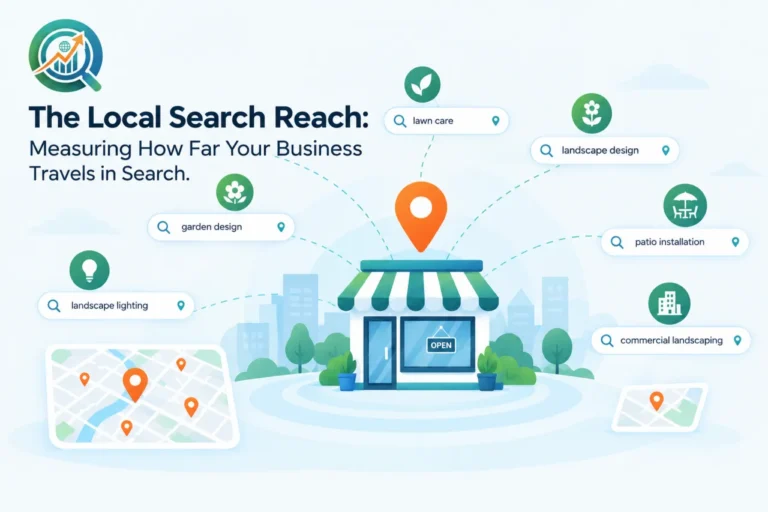
Imagine a local landscaping company that ranks well for “landscaping company near me.” That ranking may be valuable, but it does not necessarily tell the company how visible it is for searches such as “lawn maintenance,” “garden design,” “patio landscaping,” “commercial landscaping,” or “landscape lighting.” Customers interested in those services may never use the company’s broad category term. If the business is invisible for those searches, its overall search reach is narrower than its service offering would suggest.
This distinction becomes increasingly important as businesses grow. A company may add services, enter new areas, target different customer groups, or change its priorities over time. When that happens, the set of searches that matter also changes. A local search strategy that worked when the company had a single core service may not provide enough reach once the business has expanded. Tracking local search reach helps businesses recognize that change instead of assuming that strong performance for a few established keywords automatically represents strong performance across the entire market.
Why Local Search Reach Matters for Growing Businesses
Growth changes the search landscape around a business. When a company introduces a new service, it creates new reasons for potential customers to find it. When it expands into another location, new geographic searches become relevant. When it begins targeting a different customer group, the language used to describe its products or services may change as well. Each of these developments can create additional search demand that is not represented by the keywords the business has traditionally monitored.
This is one reason a business should avoid treating its keyword list as a permanent document. Search behavior can evolve alongside the company, and a keyword set that accurately represented the business two years ago may now leave important areas unexplored. A company that provides several related services may find that some categories have strong search visibility while others receive very little exposure. That difference does not automatically mean every weak category needs immediate attention, but it provides useful information about the relationship between the company’s offerings and its presence in search.
Local search reach gives businesses a way to think about visibility in terms of coverage rather than isolated success. A company may be performing extremely well in one part of its market while remaining underrepresented elsewhere. Recognizing that distinction allows business owners and marketing teams to make more informed decisions about where their attention should go. Instead of continually trying to improve the same small group of rankings, they can evaluate whether their search presence reflects the full range of customers and services they want to reach.
The Different Layers of Local Search Reach
A useful local search strategy begins by recognizing that not all searches serve the same purpose. Some searches are broad and category-based, while others are highly specific. Some are focused on a problem, some on a service, and others on a location. Looking at these different layers together can reveal whether a business has balanced search reach or whether its visibility is concentrated in only one area.
For example, a home remodeling company might have visibility for broad searches related to remodeling, but its customers may also search for kitchen remodeling, bathroom renovation, basement finishing, home additions, or specific renovation problems. A customer may also include a city, neighborhood, or nearby area in the query. Each group provides a different route through which the customer can discover the company.
A strong local search reach strategy can therefore include several categories:
- Core category searches that describe the general type of business.
- Service-specific searches connected to individual products or services.
- Problem-based searches used by customers looking for solutions.
- Location-based searches connected to cities, neighborhoods, or service areas.
- High-intent searches that suggest the customer is closer to making contact.
- Research searches used by customers comparing options or learning about a problem.
- Longer and more specific searches that reveal detailed customer needs.
The point is not to create an enormous keyword list simply for the sake of having more keywords. The purpose is to understand the different ways customers can reach the business through search and determine whether the business has meaningful visibility across those paths.
Local Search Reach Starts With the Right Keywords
The quality of a local search reach strategy depends heavily on the quality of the searches being measured. A larger list is not automatically a better list. If the keywords do not represent genuine customer needs or meaningful business opportunities, expanding the list can create more data without creating better insight.
The most useful keywords usually have a clear connection to what the business actually provides. A roofing company, for example, should understand the searches associated with roof repair, replacement, inspections, storm damage, and other relevant services it actually offers. A dental practice may need to consider searches related to general dentistry as well as specific treatments. A law firm may need to distinguish between different practice areas rather than treating every legal search as part of one broad category.
Customer language is particularly important here because businesses sometimes organize their services around terminology that customers do not use. Someone looking for a solution may describe a problem rather than use the technical name of the service. Someone who knows exactly what they want may use a highly specific phrase. Local search reach becomes more meaningful when the keyword set reflects the language customers actually use rather than the language the business prefers to use internally.
Measuring Local Search Reach Over Time
Local search reach is not something that should be measured once and then forgotten. Search visibility changes over time, and the most useful insights often come from comparing patterns across multiple periods. A ranking snapshot can tell you where a keyword stands today, but historical tracking can help reveal whether visibility is expanding, contracting, or remaining concentrated in the same areas.
This is especially useful when keywords are grouped by service or intent. Suppose a business has twenty important keywords related to three major services. If rankings improve across most searches associated with one service while the other two remain unchanged, that tells a much different story from simply saying that the business’s average ranking improved. The overall number may look positive while hiding a significant imbalance between different parts of the business.
Businesses should therefore look for patterns rather than becoming overly focused on individual movements. If several related searches begin improving together, that may indicate broader progress around a particular service or topic. If a whole group declines, it may deserve investigation. If one keyword changes significantly while everything around it remains stable, the movement may need to be interpreted differently.
The value of local search reach measurement comes from understanding direction, distribution, and consistency rather than celebrating every individual ranking change. Over time, this creates a clearer picture of whether a business is becoming easier to discover across its relevant market.
Local Search Reach and Different Customer Journeys
Customers do not all arrive at the same point in the buying journey. Some know exactly what they want and are looking for a provider. Others recognize that they have a problem but are still trying to understand the possible solutions. Some are comparing businesses, while others are researching prices, services, or differences between available options. A business that wants strong local search reach should recognize that these different stages can produce different types of searches.
This does not mean that every business needs to create content for every imaginable search. Instead, it means understanding where the most important customer journeys begin and whether the business has useful visibility at those stages. A customer who searches for “emergency HVAC repair” has a very different need from someone searching for “why is my air conditioner not cooling.” Both searches may be relevant to the same HVAC company, but they represent different situations and potentially different expectations.
This broader perspective can help businesses identify whether their search presence is overly dependent on customers who already know exactly what service they need. Expanding local search reach can mean becoming visible earlier in the customer’s research process as well as maintaining visibility when the customer moves closer to making a decision.
Finding Concentrated Areas of Search Visibility
One of the most useful things businesses can learn from local search reach is where their visibility is concentrated. A company might discover that the majority of its strong rankings come from one service category, one location, or one type of search intent. That concentration can be valuable because it may reflect an established area of strength, but it can also reveal how dependent the business is on a narrow section of the market.
For example, a company with five major services may find that most of its search visibility comes from only two. Another company may perform well in its main city but have considerably less visibility in surrounding areas that it also serves. A third may rank strongly for informational searches while having weaker visibility for searches that indicate a customer is actively looking for a provider.
These findings do not automatically determine what the business should do next. Commercial priorities, competition, resources, and customer demand all matter. What search data can provide is a clearer understanding of where the business currently has reach and where its visibility is more limited. That information gives decision-makers a stronger foundation for deciding which areas deserve further attention.
Expanding Local Search Reach Without Losing Relevance
There is an important difference between expanding search reach and simply trying to rank for more keywords. Expanding reach should not become an excuse to target unrelated searches or create pages that offer little value to customers. The strongest growth usually comes from identifying legitimate areas of relevance that are currently underrepresented.
A business can start by examining the services it provides and asking whether its search visibility reflects those services accurately. It can then look at the problems customers commonly experience, the questions they ask, and the terminology they use when looking for solutions. Location can be considered as well, particularly for businesses that serve multiple communities or operate across a defined service area.
Content should support this process by providing useful information that genuinely matches customer needs. A page created simply because a keyword exists is unlikely to provide much lasting value. A page that clearly addresses a real service, problem, or customer question has a much stronger reason to exist. The goal is to make the business discoverable in more relevant situations, not merely to increase the number of pages or tracked phrases.
Using Local Search Reach to Guide SEO Priorities
Once a business understands its local search reach, the information can become part of a broader decision-making process. Search data can help identify categories where visibility is already strong, areas where rankings are developing, and sections of the market where the business has limited exposure. These findings can then be considered alongside the company’s commercial priorities.
For example, a business may discover that one service has excellent search visibility but represents a smaller part of its commercial focus, while another important service has considerably less visibility. That difference may be worth investigating. An agency working with a client may identify a similar pattern across several locations or service categories and use the data to have a more informed conversation about priorities.
The important point is that rankings should inform decisions rather than dictate them. Search performance is one source of evidence within a larger business strategy. Local search reach becomes particularly valuable when it helps connect search visibility with real business priorities. Instead of asking only whether rankings improved, decision-makers can ask whether visibility is developing in the parts of the market that matter most.
The Role of Consistent Ranking Measurement
None of this works particularly well without consistent measurement. If rankings are checked only occasionally, it becomes difficult to distinguish genuine trends from temporary fluctuations. Regular tracking creates a historical record that allows businesses to compare performance over time and identify changes across groups of related searches.
Consistency also makes it easier to evaluate the impact of SEO work. When businesses introduce new content, focus on a service category, or make changes designed to improve local visibility, they need a way to observe what happens afterward. Not every change will produce an immediate ranking improvement, and not every ranking movement will have the same business significance. Historical data provides the context needed to interpret those developments more carefully.
This is why effective local SEO measurement is less about finding one perfect number and more about building an ongoing understanding of search performance. The longer a business measures its local search reach, the more useful its historical data can become.
Local Search Reach as a Long-Term Growth Indicator
A business that steadily expands its local search reach can become discoverable through a wider range of relevant customer searches. That does not guarantee a particular number of leads or sales, because search rankings are only one part of the customer acquisition process, but it can create a broader foundation for discovery. More relevant search paths mean customers have more opportunities to encounter the business when they are looking for the products or services it provides.
Over time, this can also make search performance easier to understand. Instead of seeing rankings as a disconnected collection of positions, a business can see how its visibility relates to its services, customer needs, locations, and market priorities. Strong performance in one area can be recognized without assuming that the entire search strategy is equally strong. Weaknesses can be identified without assuming they are automatically problems that need immediate correction.
This balanced approach is important because local SEO is not simply a race toward the highest possible ranking for every keyword. It is an ongoing process of building relevant visibility around the market a business actually serves. Local search reach provides a way to measure that broader presence and evaluate whether a company’s search visibility is keeping pace with its real-world offering.
Conclusion
Tracking local search rankings effectively means looking beyond individual positions and understanding the broader collection of searches through which customers can discover a business. A single keyword can provide useful information, but it cannot represent the entire search landscape surrounding a company. Local search reach provides a broader framework by examining how widely a business appears across relevant services, customer needs, locations, and stages of the buying journey.
The most useful approach is not to pursue visibility everywhere. It is to identify the searches that genuinely matter, organize them around meaningful business categories, monitor how rankings change over time, and use those patterns to understand where the business is reaching customers and where its search presence remains limited. This creates a more complete picture of local SEO performance and gives business owners, agencies, and marketing teams better information for making decisions.
A strong local search presence is ultimately about being discoverable when relevant customers are looking for what you provide. The broader and more relevant that presence becomes, the less dependent the business is on a small collection of searches. By measuring local search reach consistently and connecting ranking data to real customer needs, businesses can build a search strategy that reflects the full scope of their market rather than focusing on isolated ranking positions.
If you want a practical way to monitor the rankings behind your local search performance, Rankscout can help. With Keyword Tracking, Rank Monitoring, Analytics Reports, Easy Client Management, and flexible Token Top-Ups and Promo Codes, Rankscout gives businesses and agencies the tools to keep track of search performance and understand how visibility changes over time. Get started with Rankscout and bring greater clarity to your local search performance.