

Introduction
Local search can produce some of the most valuable opportunities for a growing business.
A person searching for a nearby service is often doing more than gathering information. They may be comparing providers, looking for a solution to an immediate problem, or deciding where to spend their money.
That makes local search performance more than an SEO metric.
It is a signal of how effectively a business is being discovered by people who may eventually become customers.
Yet many businesses approach local search as a collection of isolated tasks. They publish a page, update some content, target a few keywords, and then move on to the next marketing activity.
The problem is that search performance does not work in isolation.
Every improvement, decline, competitor movement, and change in customer behavior can provide useful information. The businesses that learn to connect those signals can make better decisions and build stronger visibility over time.
This creates what can be thought of as a local search performance loop.
The process is straightforward:
Observe → understand → improve → measure → adapt.
Instead of making changes based on assumptions, businesses can use what they learn from search to decide what deserves attention next.
That approach turns local search from a one-time optimization project into an ongoing growth process.
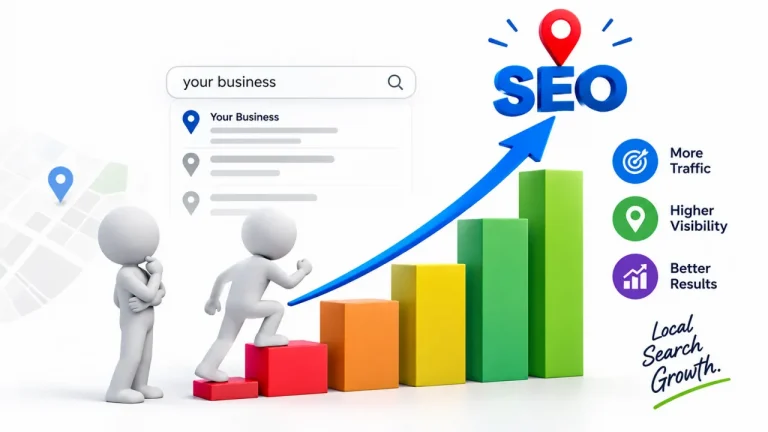
Local Search Performance Starts With the Customer
It is easy for businesses to think about search from their own perspective.
They know their services.
They know their industry terminology.
They know how they describe what they do.
Customers may think about the same business in completely different terms.
A customer is not necessarily searching for the technical name of a service. They are searching for an answer to a problem.
Someone may search for a plumber because they have a leaking pipe.
A homeowner may search for a roofing company because they noticed water damage.
A business owner may search for an accountant because tax season is approaching.
The customer begins with a need.
The business begins with a service.
Effective local search connects the two.
Find the Language Behind the Search
Understanding customer language is one of the foundations of strong local search performance.
Businesses should consider the words people might use at different stages of the buying journey.
Some searches are broad.
Others are highly specific.
Some indicate curiosity.
Others indicate urgency.
A useful starting point is to create groups of searches around:
- Products and services
- Problems customers want to solve
- Questions customers frequently ask
- Locations the business serves
- Comparisons customers may make
- Searches that indicate buying intent
This creates a broader view of what customers actually want.
It also reduces the risk of building an entire strategy around a small collection of assumptions.
Relevance Comes Before Volume
One of the most common mistakes in search marketing is assuming that more searches automatically mean better opportunities.
They do not.
A keyword may have significant search volume while producing very little value for a particular business.
Another phrase may have much lower search volume but attract people who are far more likely to become customers.
That distinction matters.
Local search performance should be evaluated based on relevance as well as visibility.
The Most Valuable Search May Not Be the Biggest
Imagine a local business that provides specialist commercial services.
A broad industry keyword might attract thousands of searches, but many of those people may be outside the company’s market or looking for something completely different.
A narrower local phrase may attract fewer searches but represent a much stronger commercial opportunity.
The second keyword could therefore be more valuable.
Businesses should ask:
- Does this search match what we sell?
- Does it attract the type of customer we want?
- Is the search relevant to our service area?
- Does the search suggest a real need?
- Could visibility for this term lead to a meaningful business opportunity?
This shifts attention from chasing numbers to understanding value.
Build a Search Strategy Around Customer Needs
Once businesses understand the searches that matter, they can begin creating a more structured content strategy.
The goal should not be to produce as much content as possible.
The goal should be to create content that helps customers move forward.
Some customers need basic information.
Others need detailed answers.
Some are comparing options.
Others are ready to contact a business.
Each situation creates a different opportunity.
Create Content for Different Stages
A useful local search strategy can include content for several stages of the customer journey.
Early-stage content can answer general questions and help people understand a problem.
Mid-stage content can explain options, services, considerations, and differences.
Decision-stage content can help customers understand what to expect when choosing a provider.
This creates a more complete search presence.
Instead of relying entirely on service pages, a business can become useful throughout the customer’s research process.
That can strengthen its overall local search performance.
Search Content Should Solve Problems
A page does not become valuable simply because it contains a target keyword.
It becomes valuable when it answers the question behind that keyword.
This distinction is important.
If someone searches for a service, they may want to know:
- What does the service involve?
- How much does it typically cost?
- When should it be used?
- What problems can it solve?
- How long does it take?
- What should they look for in a provider?
- What mistakes should they avoid?
A useful page anticipates those questions.
It gives the reader enough information to understand the subject and decide what to do next.
Avoid Creating Content for Content's Sake
Publishing regularly can be useful, but frequency should not become the main goal.
Ten weak articles are not automatically better than two excellent ones.
A business should consider whether every new page has a clear purpose.
Before publishing, ask:
What will this page help a customer understand or accomplish?
If the answer is unclear, the topic may need more work.
Strong content is easier to build when the customer problem is clear from the beginning.
Local Relevance Should Feel Natural
Location is central to local search, but businesses should avoid forcing geographic terms into every piece of content.
Repeatedly adding city names does not make a page genuinely useful.
Local relevance should come from the subject itself.
A business serving a particular area can discuss issues that matter to customers in that market. It can explain its services clearly and make its service area understandable.
This produces content that feels relevant instead of artificially localized.
Think Beyond the City Name
A local audience is not defined only by geography.
It can also be defined by needs, habits, problems, and circumstances.
A business serving homeowners may create content around homeowner concerns.
A commercial provider may focus on challenges faced by local businesses.
A retailer may create content around the buying decisions of customers in its market.
This allows businesses to develop deeper local relevance.
The result is a search presence built around people rather than geographic keywords alone.
Competitors Can Reveal Weak Spots
Local search performance should never be evaluated without considering the competitive environment.
A business might believe its website is performing well because it looks professional and contains useful information.
But search results are relative.
Customers are choosing between the businesses that appear in front of them.
That means competitors can provide valuable context.
Study What Appears Alongside You
Look at businesses that consistently appear for important searches.
Do they answer questions that your website does not?
Do they explain their services more clearly?
Do they provide more useful information?
Are they targeting topics you have overlooked?
Are there customer concerns that appear repeatedly across competing pages?
The objective is not to copy them.
It is to identify what customers are being offered and determine where your own content can be stronger.
Look for Unanswered Questions
Competitive research can reveal gaps.
Perhaps existing pages explain what a service is but fail to explain when customers need it.
Perhaps competitors discuss a service but do not address common concerns.
Perhaps the available content is generic and does not provide enough practical information.
Those gaps can become opportunities.
Sometimes the easiest way to improve local search performance is not to create something similar to what already exists.
It is to create something more useful.
Measure What Happens After You Make Changes
A major weakness in many SEO strategies is the lack of feedback.
A business makes a change but never checks what happened afterward.
That makes it difficult to know which activities are producing value.
Measurement creates the missing feedback loop.
When performance is tracked over time, businesses can see whether important search terms are moving, whether certain pages are gaining visibility, and whether improvements appear to be producing meaningful changes.
Do Not Judge Results Too Quickly
Search performance does not always change immediately.
A page may need time to establish stronger visibility.
A content update may take time to produce noticeable results.
A competitive change may affect performance gradually.
That means businesses should avoid treating every short-term movement as a final verdict.
Instead, look for sustained patterns.
A consistent upward trend is more meaningful than one isolated improvement.
Likewise, a gradual decline deserves more attention than a single poor result.
Turn Data Into Decisions
Collecting search data is only useful if the information influences what happens next.
A business should use performance data to decide where to focus its resources.
If one group of services is performing strongly, there may be opportunities to build on that momentum.
If another group is consistently weak, it may require investigation.
If certain topics produce strong engagement, they may deserve further development.
If important searches are declining, the business may need to review its content and competitive position.
This turns local search performance into a decision-making tool.
Create a Simple Priority System
Not every problem needs to be addressed immediately.
A useful way to prioritize opportunities is to consider three factors:
Business value: How important is this search or service to revenue?
Current performance: How well is the business performing today?
Opportunity: How realistic is meaningful improvement?
High-value searches with weak performance and clear opportunities should usually receive attention first.
This prevents businesses from spending excessive time on minor ranking changes while larger opportunities remain untouched.
Existing Pages Can Become Growth Assets
A business does not always need to create something new to improve local search performance.
Existing content can contain significant potential.
A page may already receive some visibility but fail to perform as well as it could.
Perhaps the information is outdated.
Perhaps the page does not fully answer customer questions.
Perhaps the structure is difficult to follow.
Perhaps the content does not match what searchers actually want.
Refreshing an existing page can sometimes be more efficient than starting from zero.
Perform Regular Content Reviews
Businesses should periodically review their most important pages.
Look for:
- Outdated information
- Missing customer questions
- Weak explanations
- Poor organization
- Unclear service descriptions
- Topics competitors cover more effectively
- Content that no longer matches customer intent
The objective is not to rewrite everything.
It is to identify meaningful opportunities for improvement.
This creates another part of the local search performance loop.
Existing content provides evidence. Evidence reveals opportunities. Opportunities lead to improvements. Improvements can then be measured.
Local Search Performance Is Connected to Business Growth
Search rankings and website traffic are useful measurements, but they should never exist separately from business goals.
A business does not need visibility simply for the sake of having visibility.
It needs visibility because customers can come from it.
That makes commercial relevance essential.
A search strategy should ultimately support outcomes such as:
- Qualified website traffic
- Customer inquiries
- Phone calls
- Appointments
- Store visits
- Product purchases
- New business opportunities
This is why businesses should avoid celebrating rankings without asking what those rankings represent.
A Better Question to Ask
Instead of asking:
“How many keywords do we rank for?”
consider asking:
“Are we becoming more visible for the searches that matter to our business?”
That question produces a much stronger strategic mindset.
A business could gain visibility for dozens of low-value phrases and see little commercial impact.
Another business might improve visibility for a smaller number of highly relevant searches and generate far better opportunities.
The second outcome is often more meaningful.
Watch for Changes in Customer Behavior
Customer behavior is not static.
People change how they search.
They may use longer phrases.
They may ask more specific questions.
They may search differently when they are ready to buy.
They may become more focused on convenience, price, speed, or expertise.
Businesses that pay attention to these changes can adapt their content strategy.
Search Behavior Can Reveal New Opportunities
Suppose customers begin asking a question that the business has never addressed.
That question could become a new content opportunity.
Suppose a service becomes more popular.
That could justify expanding the relevant content.
Suppose a previously important search becomes less relevant.
The business may need to reconsider how much effort it invests in that area.
This is why local search performance should be treated as an ongoing source of information.
Search is not just a channel for reaching customers.
It is also a window into what customers want.
Avoid the Trap of Constantly Starting Over
When results are disappointing, businesses sometimes abandon their strategy completely.
That can be a mistake.
A weak result does not always mean the entire strategy is wrong.
Sometimes one part of the strategy needs adjustment.
Perhaps the keyword selection was too broad.
Perhaps the content did not match intent.
Perhaps an important service has not received enough attention.
Perhaps the competition is stronger than expected.
Perhaps the business simply needs more time and consistency.
The solution should come from diagnosis rather than frustration.
Build on Evidence
Before making major changes, review what the data actually says.
Identify what is working.
Identify what is not.
Look for patterns.
Then make targeted improvements.
This approach reduces wasted effort and makes the overall strategy easier to manage.
Create a Repeatable Local Search Performance Loop
The strongest local search strategies are built around repeatable processes.
A simple cycle can keep efforts focused:
1. Observe
Review current performance.
Identify important searches, pages, services, and areas of opportunity.
2. Understand
Ask why performance looks the way it does.
Consider customer intent, content quality, relevance, and competition.
3. Improve
Make focused changes based on the evidence.
Do not attempt to fix every issue simultaneously.
4. Measure
Track what happens after the changes.
Look for meaningful trends rather than isolated movements.
5. Adapt
Use what you have learned to determine the next priority.
Then begin the cycle again.
This process creates momentum.
It also makes local search less dependent on guesswork.
Consistency Beats Random Activity
Local search performance can improve through steady, focused work.
That does not necessarily mean publishing every day or changing a website every week.
It means maintaining awareness and making deliberate improvements when the evidence supports them.
Businesses should resist the temptation to chase every new SEO trend.
Instead, they should focus on fundamentals:
- Understand the customer
- Target meaningful searches
- Create useful content
- Maintain local relevance
- Study the competitive environment
- Measure performance
- Learn from the results
- Improve consistently
These principles remain valuable because they are based on how customers actually search and make decisions.
Conclusion
Local search performance is not a number that businesses should check once and forget.
It is an ongoing signal.
It can show where a business is gaining visibility, where competitors are creating pressure, which customer needs are being addressed, and where new opportunities may exist.
The businesses that get the most value from local search are not necessarily the ones that make the most changes.
They are the ones that make better-informed changes.
They understand their customers.
They focus on relevant searches.
They create useful content.
They pay attention to competitors.
They measure results.
Then they use what they learn to decide what comes next.
That creates a continuous improvement cycle.
Observe. Understand. Improve. Measure. Adapt.
Over time, that cycle can transform local search from a collection of disconnected SEO tasks into a structured part of business growth.
If you want to make that process easier to manage, Rankscout provides tools designed to bring greater clarity to search performance.
With Keyword Tracking, Rank Monitoring, Analytics Reports, Easy Client Management, and Tokens and Promo Codes, Rankscout gives businesses and agencies a practical way to monitor performance and turn search data into more informed decisions.
Start using Rankscout to track, understand, and improve your local search performance.