

Introduction
One of the biggest challenges with local SEO isn’t deciding what to optimize—it’s knowing whether your efforts are actually producing results. Many businesses spend months creating content, optimizing pages, and improving their websites, yet they struggle to answer a simple question: Is our local SEO working?
The answer lies in tracking the right local SEO metrics.
Metrics provide measurable insights into your website’s performance. Instead of relying on assumptions or occasional ranking improvements, you can use data to understand how your website is performing, where visitors are coming from, which pages are delivering results, and where opportunities for improvement exist.
However, not every metric deserves equal attention. Some numbers look impressive but contribute very little to business growth, while others provide valuable insight into the effectiveness of your SEO strategy.
In this guide, you’ll learn which local SEO metrics matter most, why they are important, and how monitoring them consistently can help you make better decisions and improve your long-term search performance.
What Are Local SEO Metrics?
Local SEO metrics are measurable indicators that help evaluate how effectively your website performs in local search.
They provide insight into how users discover your website, how they interact with your content, and whether your optimization efforts are moving in the right direction.
Instead of focusing on a single number, successful businesses review several metrics together to build a complete picture of their SEO performance.
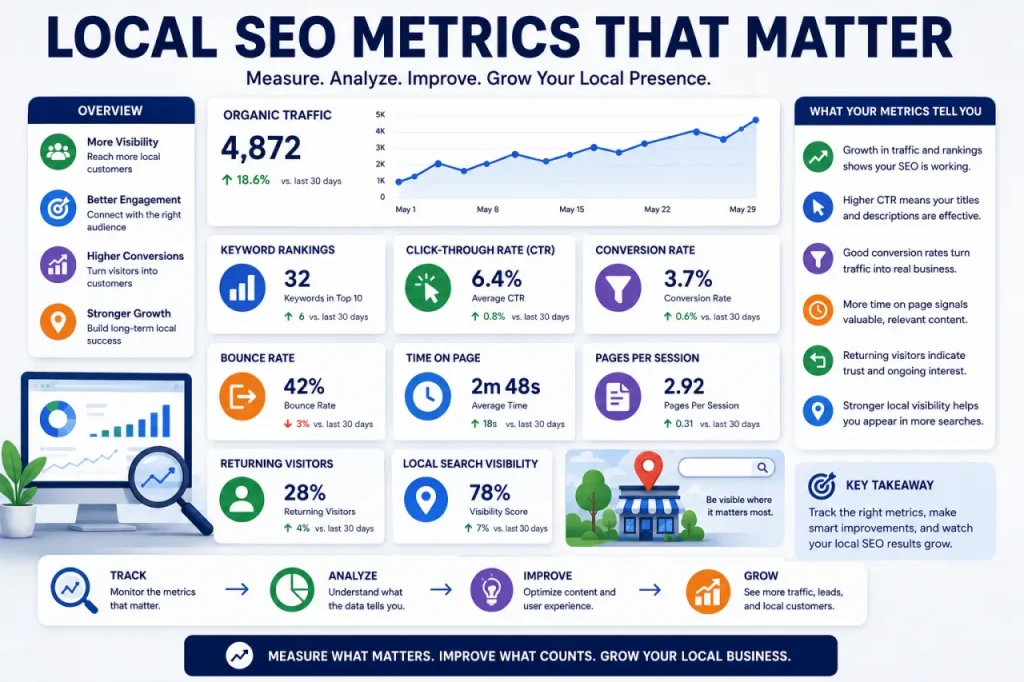
Common local SEO metrics include:
- Organic traffic
- Keyword rankings
- Click-through rate (CTR)
- Bounce rate
- Time on page
- Conversion rate
- Pages per session
- Returning visitors
- Local search visibility
Each metric tells part of the story, but together they help reveal where improvements can have the greatest impact.
Why Tracking Local SEO Metrics Matters
SEO is an ongoing process rather than a one-time project. Without measurable data, it’s difficult to know whether your strategy is working or where you should focus next.
Tracking local SEO metrics helps you:
- Measure progress over time.
- Identify successful content.
- Spot underperforming pages.
- Discover new opportunities.
- Make informed optimization decisions.
- Prioritize future work.
Data removes guesswork and allows you to focus your efforts where they matter most.
Organic Traffic
Organic traffic measures the number of visitors who reach your website through unpaid search results.
This is often one of the first metrics businesses monitor because it reflects the overall effectiveness of their SEO strategy.
Steady growth in organic traffic typically indicates that your content is becoming more visible and relevant.
However, traffic alone isn’t enough. You also need to understand whether those visitors are engaging with your website and taking meaningful actions.
Keyword Rankings
Keyword rankings show where your pages appear in search results for targeted search terms.
Monitoring rankings helps you:
- Measure SEO progress.
- Identify declining pages.
- Discover opportunities for improvement.
- Evaluate the impact of content updates.
Rather than tracking hundreds of keywords, focus on the terms that are most relevant to your business and your audience.
Click-Through Rate (CTR)
Click-through rate measures how often people click on your page after seeing it in search results.
A low CTR may indicate that your page title or meta description is not compelling enough, even if your rankings are strong.
Improving titles and descriptions can often increase traffic without changing your rankings.
Conversion Rate
Traffic is valuable only if it contributes to your business goals.
Conversion rate measures the percentage of visitors who complete a desired action, such as:
- Submitting a contact form.
- Requesting a quote.
- Booking an appointment.
- Calling your business.
- Making a purchase.
Improving conversion rates often provides a greater return than simply increasing traffic.
Time on Page
Time on page indicates how long visitors spend reading your content.
Longer engagement often suggests that visitors find your content useful and relevant.
If users leave quickly, review whether your content answers their questions clearly and provides enough depth.
Bounce Rate
Bounce rate measures the percentage of visitors who leave your website after viewing only one page.
A high bounce rate isn’t always negative, especially if a page fully answers the visitor’s question.
However, consistently high bounce rates across multiple pages may indicate issues with content quality, navigation, or user experience.
Pages Per Session
This metric shows how many pages visitors explore during a single visit.
A higher number often suggests that users are finding your website valuable and navigating naturally between related resources.
Strong internal linking can help improve this metric.
Returning Visitors
Returning visitors indicate that people find enough value in your website to come back.
Repeat visits often reflect trust and growing brand recognition.
While attracting new visitors is important, encouraging repeat engagement can strengthen long-term business relationships.
Local Search Visibility
Local search visibility measures how often your business appears for relevant local searches.
Although rankings fluctuate naturally, monitoring overall visibility provides a broader understanding of your progress.
Focus on long-term trends rather than daily changes.
How to Interpret Metrics Together
No single metric tells the whole story.
For example:
- High traffic with low conversions may indicate poor user experience.
- Strong rankings with low CTR may suggest weak page titles.
- High engagement but declining traffic may point to keyword competition.
Looking at multiple metrics together provides more meaningful insights than reviewing each individually.
Common Mistakes When Measuring Local SEO
Avoid these common pitfalls.
Focusing Only on Rankings
Rankings matter, but they should be considered alongside engagement and conversions.
Checking Metrics Too Frequently
SEO results take time. Daily monitoring often leads to unnecessary reactions.
Ignoring User Behavior
Understanding how visitors interact with your content is just as important as attracting them.
Measuring Vanity Metrics
Choose metrics that support business goals rather than numbers that simply look impressive.
Failing to Review Trends
Look for consistent patterns over weeks and months instead of reacting to short-term fluctuations.
Best Practices for Tracking Local SEO Metrics
To get the most value from your data:
- Define clear objectives.
- Track meaningful KPIs.
- Review performance regularly.
- Compare long-term trends.
- Improve underperforming pages.
- Refresh successful content.
- Continue testing and refining.
Consistent measurement supports continuous improvement.
Frequently Asked Questions
Which local SEO metric is the most important?
There is no single most important metric. Organic traffic, conversions, keyword rankings, and engagement all contribute to understanding overall performance.
How often should I review local SEO metrics?
Monthly reviews provide enough data to identify trends while avoiding unnecessary focus on short-term fluctuations.
Can metrics improve SEO by themselves?
No. Metrics simply provide insight. The improvements you make based on those insights are what support better search performance.
Should small businesses track local SEO metrics?
Absolutely. Monitoring performance helps businesses of every size make better marketing decisions and prioritize future optimization efforts.
Conclusion
Tracking the right local SEO metrics transforms SEO from a guessing game into a measurable, data-driven process. Rather than relying on assumptions, you can use meaningful performance indicators to understand what’s working, identify areas for improvement, and refine your strategy over time.
Remember that success isn’t defined by one metric alone. Organic traffic, keyword rankings, engagement, and conversions all work together to paint a complete picture of your website’s performance. By reviewing these metrics consistently and acting on the insights they provide, you’ll be better equipped to build sustainable visibility and attract more local customers.
The businesses that succeed in local SEO are rarely those that make the biggest changes overnight. They’re the ones that measure, learn, improve, and repeat.
The most successful SEO strategies are built on continuous improvement. By regularly reviewing your website’s performance and focusing on the metrics that truly matter, you can make informed decisions that strengthen your online presence over time.
Start measuring your progress, refine your content, and continue optimizing your website with confidence. Every improvement you make today brings you one step closer to greater visibility, stronger engagement, and long-term local SEO success.