

Introduction
Local search is built on trust. When people search for a business nearby, they want fast, reliable answers that help them decide who to contact, visit, or hire. Search engines are trying to deliver the same thing: the most trustworthy and relevant results for each search.
One of the simplest but most overlooked ways to build that trust is by maintaining NAP consistency.
NAP stands for Name, Address, and Phone Number. These three pieces of information may seem basic, but they play a major role in how search engines understand your business across the web. If your details are inconsistent, incomplete, or outdated, it can create confusion for both users and search engines. That confusion can weaken your visibility in local search.
The good news is that NAP consistency is not complicated. It is a practical, manageable part of local SEO that can make a meaningful difference over time. In this guide, you will learn what NAP consistency is, why it matters, where problems usually happen, and how to keep your business information accurate across your website and online listings.
What Is NAP Consistency?
NAP consistency means your business name, address, and phone number appear the same way everywhere they are listed online.
That includes:
- Your website
- Business directories
- Social media profiles
- Industry listings
- Review platforms
- Local citations
- Map listings
The goal is not just to have the same contact information somewhere on the internet. The goal is to have that information formatted and presented consistently across all important sources.
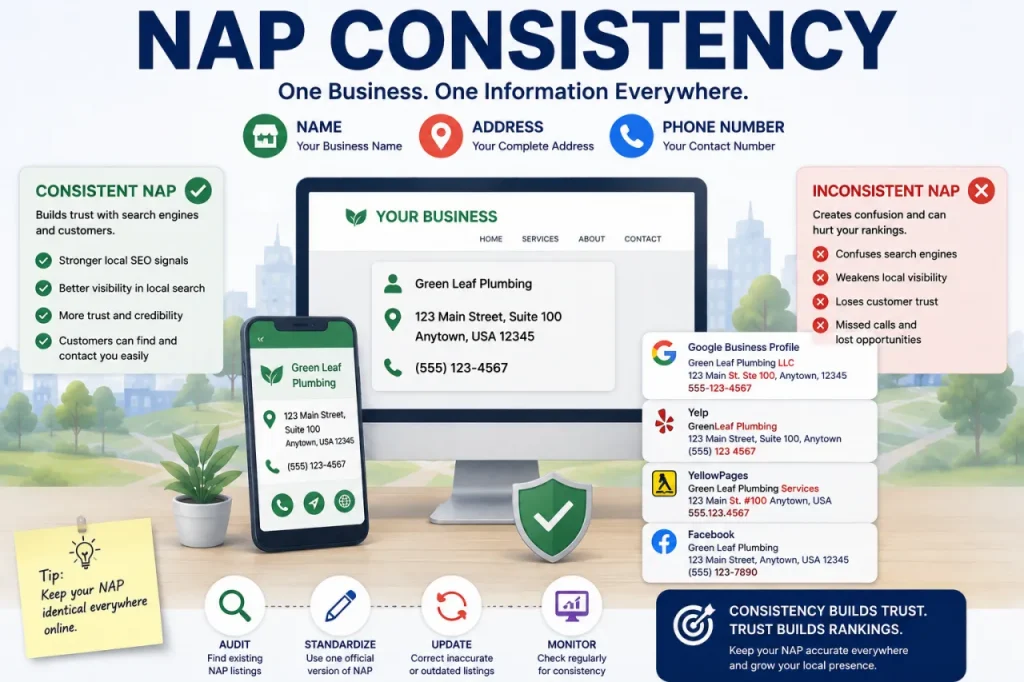
For example, if your business name is listed as “Green Leaf Plumbing” on your website, it should not appear as “GreenLeaf Plumbing LLC” on one directory and “Green Leaf Plumbing Services” on another unless those variations are intentional and standardized.
The same goes for address formatting and phone numbers. Small differences may seem harmless to people, but they can create uncertainty in search systems that rely on matching data.
Why NAP Consistency Matters for Local SEO
Search engines use many signals to determine whether a business is legitimate, relevant, and trustworthy. Consistent business information helps reinforce those signals.
When your NAP details match across multiple sources, it becomes easier for search engines to associate those references with the same business entity. That can strengthen confidence in your business profile and help improve local visibility over time.
NAP consistency matters because it can:
- Reduce confusion about your business identity
- Improve trust with search engines
- Make your information easier for customers to verify
- Support stronger local SEO signals
- Help people contact you without friction
If someone finds your business online and sees conflicting contact details, they may lose confidence and move on to a competitor. Accuracy builds credibility.
How Inconsistent NAP Hurts Visibility
Even small differences can cause problems.
A missing suite number, a different phone format, or an old business address can create inconsistencies that make it harder for search engines to interpret your information. That does not mean your business will disappear from search results immediately, but it can weaken the clarity of your local presence.
Common problems include:
- Different versions of the business name
- Old or moved addresses still appearing online
- Multiple phone numbers in circulation
- Abbreviated and full street names used inconsistently
- Different formatting across directories
For users, this can create frustration. For search engines, it can create uncertainty. Neither is good for local SEO.
Where NAP Information Should Be Consistent
Your NAP details should be consistent across every major place your business appears online.
This typically includes:
- Your homepage
- Contact page
- Footer or sitewide business info
- Service area pages
- Business directories
- Social profiles
- Map profiles
- Local listings
- Industry-specific platforms
Your website is often the primary source of truth, so it should be the place where your official business information is most clear and most current.
If your business has multiple locations, each location should have its own accurate and clearly structured contact information. That information should also match the correct location pages and listings for that specific branch.
How to Audit Your NAP Consistency
The first step to improving NAP consistency is knowing where inconsistencies exist.
A basic audit can help you identify problems across the web.
Start by reviewing:
- Your website homepage
- Contact page
- Footer details
- Major directory listings
- Social media bios
- Business profile pages
- Old marketing materials that may still be online
Look for differences in:
- Business name spelling
- Street abbreviations
- Suite or unit formatting
- Phone number format
- Old addresses
- Alternate business names
- Inactive listings
Make a list of every version you find. Once you know what is inconsistent, you can begin standardizing it.
Choosing a Standard Format
Before you update anything, decide what your official business information should look like.
That means choosing one standard version of:
- Your business name
- Your address format
- Your phone number format
For example, decide whether you will write:
- Street or St.
- Suite or Ste.
- Phone number with dashes, spaces, or parentheses
Once you choose a format, use it everywhere.
Consistency matters more than style preference. The key is to keep your information uniform.
Fixing Your Website First
Your website should usually be the first place you correct.
If your website contains inconsistent or outdated NAP information, that creates a problem before you even get to external listings.
Check these areas first:
- Homepage footer
- Contact page
- About page
- Location pages
- Service area pages
- Website schema or structured data
Make sure the information is accurate and matches your chosen standard format.
If you recently moved, changed phone numbers, or rebranded, update every location on your site where the old information might still appear.
Updating Business Listings and Directories
After your website is corrected, move on to external listings.
Focus on the most important and authoritative sources first. These often include major business directories, map services, and platforms your customers are most likely to use.
When updating listings, keep the following in mind:
- Use the same business name everywhere
- Match the address exactly
- Standardize the phone number
- Remove duplicate or outdated listings where possible
- Make sure old data is not still live on forgotten profiles
This process can take time, but it is worth it. The more consistent your business information becomes, the stronger and clearer your local presence will be.
NAP Consistency for Multi-Location Businesses
If your business has multiple locations, NAP consistency becomes even more important.
Each location should have:
- Its own accurate business name if needed
- Its own address
- Its own phone number if applicable
- Its own page on your website
- Matching local listings
Do not mix details from one location into another. That creates confusion for both users and search engines.
Make sure each branch or office is represented accurately and separately wherever needed.
NAP and Mobile Search Behavior
Many local searches happen on mobile devices. That means customers often want fast answers and immediate contact options.
If your NAP information is inconsistent, mobile users may have a harder time calling the right number or finding the right location. They are less likely to spend time double-checking details.
Accurate, easy-to-find contact information helps users take action quickly. That improves the experience and supports conversions.
NAP Consistency and Local Trust
Trust is one of the most important parts of local SEO.
When your business details are consistent, your business appears more established and reliable. When they are inconsistent, it can feel disorganized or outdated.
Think of NAP consistency as part of your brand presentation. It shows that your business is active, professional, and easy to contact.
Even though it is a technical detail, it has a real effect on how customers perceive you.
Common Mistakes to Avoid
Businesses often create NAP issues without realizing it.
Some of the most common mistakes include:
Using Multiple Business Names
Do not alternate between slightly different versions of your business name unless you have a clear and consistent reason to do so.
Leaving Old Listings Unchanged
If you move offices or change numbers, old directory entries can continue causing confusion.
Ignoring Social Profiles
Social pages often get overlooked, but they still matter.
Inconsistent Formatting
Even when the details are technically correct, inconsistent formatting can still create noise.
Forgetting Structured Data
Your website’s structured data should match your visible NAP information.
Best Practices for Maintaining NAP Consistency
A few simple habits can help you keep your business information accurate long term.
- Decide on one official format for your business details.
- Update your website first after any change.
- Review listings regularly.
- Remove duplicates when possible.
- Keep a record of where your business appears online.
- Check your information after rebranding, moving, or changing phone systems.
The more disciplined you are about maintaining accuracy, the easier it becomes to avoid problems later.
How Often Should You Review NAP Information?
You do not need to check every listing every day, but you should review your business information on a regular schedule.
A good approach is to review it:
- After any business change
- Every few months
- During SEO audits
- When launching new pages or campaigns
This helps you catch problems early before they spread.
NAP Consistency and the Bigger Local SEO Picture
NAP consistency is only one part of local SEO, but it supports many of the other parts.
When your business details are accurate, it helps strengthen:
- Local trust
- Citation quality
- Website credibility
- User confidence
- Search engine clarity
That makes your other SEO efforts more effective. Good content, strong service pages, and helpful local information all work better when your business identity is clear and consistent.
Conclusion
NAP consistency may not sound exciting, but it is one of the most important foundations of local SEO. Accurate and consistent business information helps search engines understand your business, helps customers trust what they see, and reduces the friction that can prevent someone from contacting you.
If your website, listings, and profiles all tell the same story, your business looks more credible and organized. That kind of clarity matters in local search, where small details can have a big impact.
The best part is that improving NAP consistency is completely within your control. You do not need a huge budget or a complicated strategy. You just need to review your information carefully, standardize your details, and keep them accurate across the web.
Make NAP consistency part of your ongoing local SEO process, and you will build a stronger foundation for visibility, trust, and long-term growth.
Accurate business information is just one piece of the local SEO puzzle, but it is an important one. When your details stay consistent, it becomes easier to build trust and measure the impact of your broader marketing efforts.
If you are serious about improving your local visibility, sign up for Rankscout and start tracking your progress with confidence. Stay focused on the work that moves your business forward and build a stronger presence in local search over time.