

Introduction
If you’ve ever searched for a local business online, you’ve probably noticed that some companies consistently appear near the top of the results while others are much harder to find. This isn’t random. Search engines evaluate a wide range of signals to determine which businesses are most relevant for every search.
Understanding local search ranking factors can help businesses make smarter SEO decisions. Instead of guessing what might improve visibility, you can focus on the elements that genuinely influence how search engines evaluate your website.
It’s important to remember that there isn’t a single ranking factor that guarantees success. Strong local SEO comes from combining high-quality content, excellent user experience, thoughtful website organization, and consistent optimization over time.
This guide explains the most important local search ranking factors and provides practical advice on how you can strengthen each one.
What Are Local Search Ranking Factors?
Local search ranking factors are the signals search engines use to decide which websites should appear for searches with local intent.
These signals help determine:
- Which pages are most relevant.
- Which businesses provide the best user experience.
- Which websites demonstrate authority and trust.
- Which content best answers a user’s search.
No website is perfect in every area, but businesses that perform well across multiple ranking factors often enjoy greater visibility.
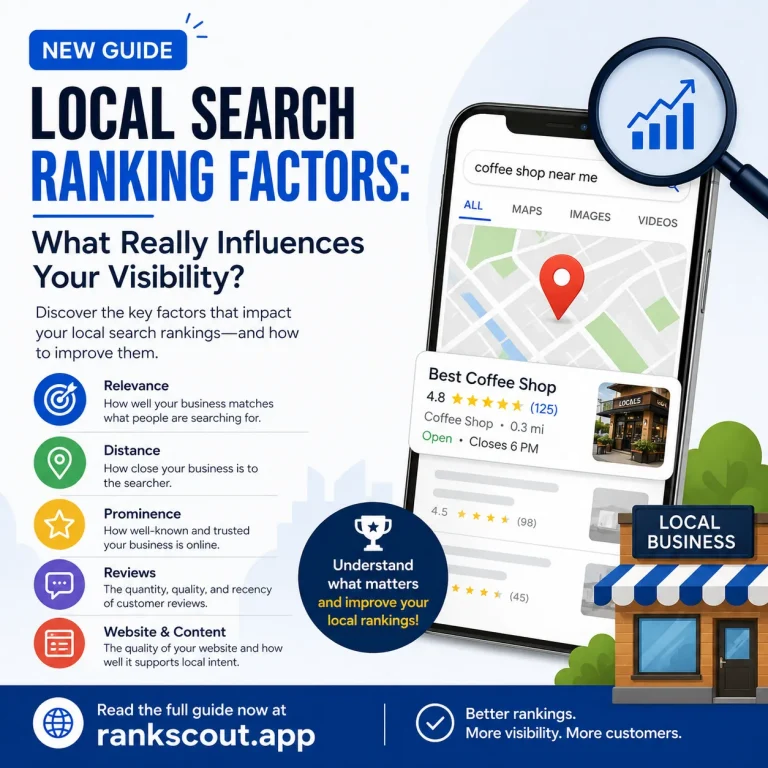
Relevance: Matching User Intent
One of the strongest local search ranking factors is relevance.
Search engines want to display pages that closely match what users are searching for.
For example, if someone searches for:
- Emergency plumber in Austin
- Family dentist in Seattle
- Kitchen remodeling Chicago
Search engines look for pages specifically focused on those services.
Creating dedicated service pages helps demonstrate relevance more effectively than trying to cover every service on a single page.
High-Quality Content
Content remains one of the most important ranking factors.
Helpful content should:
- Answer customer questions.
- Explain services clearly.
- Provide useful advice.
- Solve common problems.
- Be easy to understand.
Rather than writing solely for search engines, focus on creating content your audience genuinely finds valuable.
Search engines increasingly reward websites that satisfy users.
Keyword Optimization
Keywords help search engines understand what each page is about.
Your primary keyword should appear naturally in areas such as:
- Page titles
- Main headings
- Opening paragraphs
- Subheadings where appropriate
- Meta descriptions
Avoid overusing keywords.
Natural writing almost always performs better than repetitive optimization.
Website Structure
A well-organized website is easier for both visitors and search engines to navigate.
Good structure includes:
- Clear navigation menus.
- Logical page hierarchy.
- Descriptive URLs.
- Internal linking.
- Organized categories.
When users can quickly find what they need, engagement often improves.
User Experience
Search engines pay attention to how visitors interact with websites.
Strong user experience includes:
- Fast page loading.
- Mobile-friendly design.
- Readable content.
- Clear navigation.
- Simple layouts.
Visitors who enjoy using your website are more likely to stay longer and explore additional pages.
Internal Linking
Internal links connect related pages together.
For example:
- Service pages can link to educational articles.
- Beginner guides can link to advanced resources.
- Related blog posts can reference one another.
Benefits include:
- Better navigation.
- Improved page discovery.
- Stronger topical authority.
- More opportunities for visitors to engage.
Content Depth
Thin pages often struggle to compete against comprehensive resources.
A quality page should fully answer the reader’s questions.
Rather than writing 300 words on a topic, consider creating a detailed guide that explores multiple aspects of the subject.
Comprehensive content often provides greater long-term value.
Fresh Content
Search engines prefer content that remains accurate and useful.
Regularly update:
- Statistics.
- Examples.
- Images.
- Internal links.
- Industry developments.
Refreshing existing articles helps maintain their relevance.
Topic Authority
Search engines increasingly evaluate how thoroughly a website covers a subject.
Instead of publishing isolated articles, build groups of related content.
For example:
- Local SEO strategy
- Local SEO checklist
- Local SEO tips
- Local search optimization
- Local keyword research
- Local search ranking factors
Together, these resources demonstrate expertise within your niche.
Mobile Optimization
Most local searches occur on smartphones.
Your website should:
- Load quickly.
- Display correctly on all screen sizes.
- Use readable fonts.
- Feature tap-friendly navigation.
- Make forms easy to complete.
A positive mobile experience benefits both users and search visibility.
Page Speed
Visitors expect websites to load quickly.
Slow pages can increase frustration and reduce engagement.
Ways to improve speed include:
- Compressing images.
- Minimizing unnecessary scripts.
- Optimizing file sizes.
- Using efficient hosting.
Performance improvements create a smoother experience.
Search Intent
One of the most overlooked local search ranking factors is matching search intent.
Different users have different goals.
Some searches are informational.
Others compare businesses.
Many indicate immediate buying intent.
Creating content that aligns with each stage of the customer journey improves overall relevance.
Consistent Publishing
Publishing useful content consistently helps build authority over time.
Potential content includes:
- Beginner guides.
- Frequently asked questions.
- Cost articles.
- Industry news.
- Maintenance advice.
- Seasonal tips.
The goal is to continually expand your knowledge base.
Performance Monitoring
SEO should never rely on assumptions.
Review your performance regularly by monitoring:
- Organic traffic.
- Keyword rankings.
- Visitor engagement.
- Time on page.
- Click-through rates.
These insights help identify opportunities for improvement.
Common Mistakes That Affect Local Search Rankings
Avoid these common problems.
Publishing Duplicate Content
Every page should provide unique value.
Ignoring User Experience
Even excellent content struggles if visitors find your website difficult to use.
Weak Internal Linking
Related pages should support one another through natural links.
Keyword Stuffing
Use keywords naturally rather than forcing them into every paragraph.
Expecting Immediate Results
SEO rewards patience and consistency.
Long-term improvements usually outperform quick fixes.
Best Practices for Improving Local Search Ranking Factors
To strengthen your local SEO:
- Create detailed service pages.
- Publish helpful educational content.
- Improve website navigation.
- Optimize page speed.
- Strengthen internal links.
- Keep content updated.
- Build topic clusters.
- Focus on user experience.
- Monitor performance regularly.
Small improvements across multiple areas often produce the strongest long-term results.
Frequently Asked Questions
Can one ranking factor guarantee higher rankings?
No. Search engines evaluate many signals together, so focusing on overall website quality is more effective than chasing a single factor.
How often should I update my content?
Review important pages several times each year to ensure information remains accurate, useful, and relevant.
Is user experience really important for local SEO?
Yes. A fast, mobile-friendly website with clear navigation creates a better experience for visitors, which supports long-term SEO performance.
How long does it take to improve local rankings?
Results vary depending on your industry, competition, and the quality of your website. Consistent improvements over several months generally produce the best outcomes.
Conclusion
Understanding local search ranking factors gives businesses a clearer path toward improving their online visibility. While search engines consider many different signals, the websites that consistently perform well usually share the same characteristics: they provide valuable content, offer an excellent user experience, organize information effectively, and continue improving over time.
Rather than searching for shortcuts, focus on building a website that genuinely helps your audience. Publish informative content, refine your existing pages, strengthen your internal linking, and monitor your progress regularly. These steady improvements build authority, increase trust, and create a stronger foundation for long-term local SEO success.
Remember that successful SEO is never a one-time task. Continue learning, updating your content, and responding to your customers’ needs, and your website will be well positioned to earn greater visibility in local search for years to come.
Learning about local search ranking factors is only the first step. Putting that knowledge into action is what leads to real results.
Whether you’re optimizing existing pages, creating helpful new content, or monitoring how your website performs over time, having reliable insights can help you make better SEO decisions with confidence.
If you’re ready to take your local SEO strategy to the next level, sign up for Rankscout today and start tracking your progress, measuring your growth, and making data-driven improvements that help your business get found online.